Christ and the Sign of Jonah

3 Jun

Christ and the Sign of Jonah

Read Jonah chapters 1-4.

I’ve always loved the story of Jonah. I enjoy sea adventures and missionary stories. I like that the Bible records people as they really are, with their
failures, weaknesses, biases, bad moods, and sins.  It reinforces the truth of Scripture and gives hope for someone like myself.
Jonah was a type of Christ in two ways; in the ways they were dissimilar and in the ways they were similar.

First in the ways they were dissimilar.  Jonah was called to preach to the Ninevites because of their great wickedness.  He was a prophet. Prophets prophecy. Instead he ran in the opposite direction and hitched a ride on a ship going to Tarshish, hoping to hide from God.  Jonah 1: 1-3

Whereas, Jesus, knowing what was awaiting Him in Jerusalem, did not shrink back from His mission, but, “He steadfastly set His face to go to Jerusalem…” Luke 9:51

Christ was perfect, whereas Jonah was far from an exemplary character.  He was a disobedient prophet who thought he could hide from God.  He appears to be cowardly.  That’s our first impression of him because of his reluctance to go to the Ninevites, who were a feared people and enemy of Israel.
Yet, later on, we see his real reason for running.  It wasn’t fear of the Ninevites.  It was fear of the mercy of God on them.

“But it displeased Jonah exceedingly, and he became angry.  So he prayed to the LORD, and said, ‘Ah, LORD, was not this what I said when I was still in my country?  Therefore I fled previously to Tarshish: for I know that You are a gracious and merciful God, slow to anger and abundant in lovingkindness, One who relents from doing harm.’” Jonah 4:1, 2

To Jonah, who knew the character of God, it was just as he’d feared.  God would spare the Ninevites from wrath.  He would show mercy.  The last thing Jonah
hoped for was that God would show mercy to Israel’s most hated enemy.  They didn’t deserve it.  (But Jonah, that’s why it’s called mercy!) We are saved from
getting what our sins deserve.  I am saved from getting what I deserve, and you, Jonah are saved from getting what you deserve as well.  No one merits salvation by the works of their hands.

“For by grace you have been saved through faith, and that not of yourselves; it is the gift of God, not of works, lest anyone should boast.” Eph. 2:8

Jonah was a type of Christ in relation to his judgment.  The scribes and Pharisees were asking for a sign, even though He had just healed a blind, mute,
demon-possessed man right before their eyes. Jesus did not do miracles on command. So He told them,

“An evil and adulterous generation seeks after a sign, and no sign will be given to it except the sign of the prophet Jonah. For as Jonah was three days and three nights in the belly of the great fish, so will the Son of Man be three days and three nights in the heart of the earth.”
Matthew 12: 39, 40

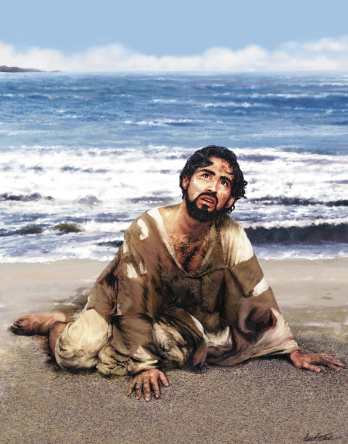
Christ was like Jonah in that He suffered the judgment of God, and separation from Him for three days.  As Jonah was in his fish-prison for three days, so
Christ was in his tomb-prison for three days. Jonah realizes his watery grave is equivalent to being in hell.

“…Out of the belly of Sheol I cried, and You heard my voice, For you cast me into the deep, into the heart of the seas, and the floods surrounded me; all
your billows and your waves passed over me.”
   Jonah 2:2,3

For Jonah, the worst aspect of death was separation from the presence of the Lord.

I have been cast out of your sight.” Jonah2:4

For Christ, the worst aspect of the cross was the separation from His father.

“My God, my God, why have you forsaken me?” Mark 15:34

Jonah now longs for the presence of God that he earlier sought to escape.

“Yet I will look again toward your holy temple.” Jonah 2: 4b

Jonah recognizes he is in the realm of death and only God can save him.

“Yet you have brought up my life from the pit, O LORD, my God. Salvation is of the LORD.” Jonah 2: 6b, 9b.

Jonah was as good as dead and restored to life again.  He fulfilled His mission and it resulted in the salvation of his enemies.  In the same way, but on a much
grander scale, Christ’s fulfillment of His mission, dying on the cross, being buried in the earth and resurrected resulted in the salvation of His enemies.
“For if when we were enemies we were reconciled to God through the death of His Son, much more, having been reconciled, we shall be saved by His life.”   Romans 5:10

When Jesus gives this cryptic message about the sign of Jonah to the scribes and Pharisees, he adds a condemnation.

“The men of Nineveh will rise up in the judgment with this generation and condemn it, because they repented at the preaching of Jonah; and indeed a
greater than Jonah is here.”   
Matthew 12: 41

Jesus is commenting on the efficacy of Jonah’s preaching. The Ninevites recognized the message of divine authority, even in the absence of miraculous
signs, and they responded with genuine repentance.  Christ does signs that no one has ever done, i.e. healing the blind and deaf, and yet the people of His
generation would not believe.  Therefore, their punishment is greater.

P– “Lord, give me the courage to share the gospel with others and not judge whether they ‘deserve’ to hear it or not, or whether I think they’re likely to accept my message. Soften my heart and help me to see them as You do, as You saw me when I was lost.”

Q– Do you ever feel that someone doesn’t deserve God’s mercy, like a child molester who repents before they die? Do you resent that they get that they will be in Heaven along with you, who have served God your whole life? God forbid! Don’t be like the elder brother in the parable of the prodigal son. Rejoice whenever you see God’s mercy to sinners, because He has extended it to you, too. If you feel this way, it may be that you think we are saved by                              works, or condemned because of our actions. No, it is all of grace. Our good works don’t merit Heaven for us; God’s grace does. The child’s molester’s sin doesn’t exclude him, because God’s mercy reaches the vilest sinner.

R– Ask God to help you to truly see both His holiness and your sin, and you’ll be amazed at His grace. If a superior attitude has kept you from witnessing to someone you feel is beyond the reach of God’s grace, repent and pray for that person. Ask God to save them. It’s hard to hate someone for whom you’re praying.

Christ as the Plumb Line in Amos

7 May

Read Amos Chapter 7

“Thus He showed me: Behold, the Lord stood on a wall made with a plumb line, with a plumb line in His hand.  And the LORD said to me, ‘Amos, what do you see?’  And I said, ‘A plumb line.’  Then the Lord said: ‘Behold, I am setting a plumb line in the midst of My people Israel; I will not pass by them anymore.” Amos 7: 7, 8

Truly, these times of ignorance God overlooked, but now commands all men everywhere to repent, because He has appointed a day on which He will judge the world in righteousness by the Man whom He has ordained.  He has given assurance of this to all by raising Him from the dead.” Acts 17: 30, 31

 “For there is no difference, for all have sinned and fall short of the glory of God, being justified freely by His grace through the redemption that is in Christ Jesus, whom God set forth as a propitiation by His blood, through faith, to demonstrate His righteousness, because in His forbearance God had passed over the sins that were previously committed, to demonstrate at the present time His righteousness, that He might be just and the justifier of the one who has faith in Jesus.” Romans 3:23-26

I’ll never be accused of being a carpenter; not enough evidence.  I’ve been known to hammer a screw into a wall.  But I’m told that when you’re building a structure, you need a few tools to ensure that your structure won’t topple over.

One tool you need is a level.  That’s the yardstick thingie with a bubble in the middle.  It makes sure your cross beams are straight and not sloping ever so slightly to one side or the other.  It will ensure your roof is sitting on straight and won’t fall on you, and your floors are level.  Hence the name.   It deals with the horizontal plane.

The other tool is a plumb-bob.  (Yes, that’s really its name.) It deals with the vertical plane.  It is basically a weighted string that you suspend in front of your wall at the ceiling. It uses gravity to test what is true, or plumb. It makes sure your wall isn’t leaning backward or forward.  I’m told the Leaning Tower of Pisa is leaning because of the ground it’s on, and not poor building practices; nevertheless, if you used a plumb-bob in it, you’d see how far off it is from being straight.

In this passage, Amos refers to a plumb line let down from heaven into their midst.  This will be the new way to judge ourselves, whether we’re off the mark or not.  Christ was the perfect God-man who came down from Heaven to set the standard, showing us duty, devotion and love for God.  His holiness is our standard.

We use these two “moral tools” as we judge ourselves and others. The problem is that people would rather use a level.  We look at the person next to us and say, “I’m not as bad as he,” or “I’ve never murdered anyone.”  When you use a level, you can always come out on top of someone else, morally, because there are plenty of despots, dictators and criminals in the world.  You can convince yourself you’re not so bad.  You may even convince yourself you’re quite an upstanding person.

Consider, though, that the level that God uses is not within the reach of man.  If you tried to jump to the moon, you wouldn’t reach it.  Even if you started on the highest mountain, you still wouldn’t reach this standard.  “For all have sinned and fall short of the glory of God.”   Romans 3:23 Comparing ourselves horizontally doesn’t work, since we all fall short of God’s standard of perfection.  “There is none who does good.  No, not even one.”  Romans 3:12c

But we see the Perfection of Christ.  Horizontally, compared to all men, He alone met God’s standard.  He was “holy, blameless, and undefiled, separate from sinners.”  Heb.7:26  We are not.

But there’s more.  Not only are we ‘not level’, but we’re not ‘plumb’.

And then vertically, He came down from Heaven, into our midst.  He was morally upright and pure: the standard which shows how much we are teetering and about to fall, like the leaning tower of Pisa.  We are blind to this in ourselves as well, especially the average person.  But you don’t ask a skunk if he smells.

Christ lived the perfectly obedient life we could never live.   He is our righteousness.  Since we have none of our own, we must cast ourselves on His mercy; hide ourselves in Him, so that when God looks on us, He sees the righteousness of Christ imputed to us.

Since Christ has come into the world, God will no longer overlook sin.  He dealt with it once and for all. The Old Testament saints looked forward to the Passover Lamb to come, we look back on Him. Since God has now provided a better sacrifice, there is no going back to the old way.  It won’t do. The standard is set, and since we cannot meet it, we must flee to Him as our Substitute.  The vertical and horizontal planes are met perfectly in the Cross of Christ.

Prayer– “Forgive me Lord, when I look at others and compare myself to them. Help me to see You as my standard, so I won’t be critical of others, or haughty or proud. Thank You for living a perfect life as my Substitute, so I have no reason to be discouraged in my failures.”

Questions-Do you find that even as a believer, you compare yourself to others? Do you find yourself prone to be proud, envious or critical of others?

Response-Contemplate the following verses:  “Who makes you to differ from one another? And what do you have that you did not receive?”1 Cor.4:7 “Let each of you look out not only for his own interests, but also for the interests of others.” Phil. 2:4

Do something to encourage or build someone up today.

Christ as the Veil in Exodus

4 May


Read 

Exodus 26:31-35
Hebrews 10:19, 20
2 Cor.3:14-16
Matt.27:51
Luke 9:28-36
 
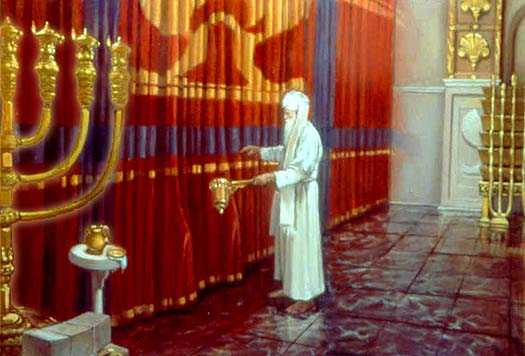
A veil covers, hides, obscures, separates. The veil spoken of in the O.T. was not a flimsy, sheer veil, but a very heavy curtain. It was one curtain, not two halves. The High Priest would have had to push it to one side to enter the Holy of Holies, once a year on the Day of Atonement.

Because he could not be certain that God would accept the offering of blood on the Day of Atonement, he would have a rope secured around his ankle. That way, if God didn’t accept the offering, and instead struck the High Priest dead, no one would have to go in to collect his body and possibly suffer the same fate.
The rope would allow them to drag his body out. This rope was not actually prescribed by God, but it showed they feared God and knew they were required to do things His way.

This curtain signified separation between God and man. We are separated or estranged from God due to our rebellion and sin. We cannot just saunter into
God’s presence. He must be approached His way, in the manner He has prescribed. He must be approached with blood, to remind us that sin equals death.

Likewise, veils cover and obscure. Christ’s glory as the second Person of the Trinity was veiled in flesh. It was hidden from view. The transfiguration peeled
back the veil slightly, to allow the disciples a glimpse of the glory of the One Whom they followed. (Luke 9:28-36).

Because Jesus looked like an ordinary Jewish man, there was nothing in his appearance to make him stand out. (Isaiah 53:2). He did not have a halo of light around His head; not in the stable, not in the garden, not on the cross. In fact, when they came to arrest him in Gethsemane, they had to have a pre-arranged sign (Judas’ kiss) in order to recognize him.

A veil also hides or conceals. Like a veil worn over a face conceals beauty or reflects modesty, or a veil on the head shows submission, it can also signify
blindness.

“But their minds were blinded. For until this day the same veil remains unlifted in the reading of the Old Testament, because the veil is taken away in Christ. But even to this day, when Moses is read, a veil lies on their heart. Nevertheless, when one turns to the Lord, the veil is taken away.” 2 Cor. 3:14-16

 The Jews read the Old Testament and yet they don’t see what we see. We see Christ throughout Scripture. They don’t. Paul says the reason is that they have a veil over their heart. That veil is unbelief. When the veil is taken away, they see that Jesus is the long-awaited Messiah.

Christ is like the veil that separated the Holy Place from the Holy of Holies, in the Tabernacle and Temple. His glory was veiled, or covered in a body made of flesh. When that flesh was torn on the cross, He provided a way to end our estrangement with God, and be reconciled to Him.

“Therefore brethren, having boldness to enter the Holiest by the blood of Jesus, by a new and living way consecrated for us, trough the veil, that is, His flesh.” Heb. 10:19, 20

While He was on the cross, the veil in the temple was torn in two, from top to bottom, and a way was made to approach God.

“Then, behold, the veil of the temple was torn in two from top to bottom, and the earth quaked, and the rocks were split.” Matt. 27:51

We can approach without fear of death! We don’t need ropes around our feet, just in case He won’t accept us.

“All that the Father gives Me will come to Me, and the one who comes to Me, I will by no means  cast out.” John 6:37

We are welcomed into His presence. I like to think that tearing the veil in the temple would have given God the Father some satisfaction, much like Jesus’ victory cry on the cross, “Finished!” God tore up the record of offences against us; the sins that separated us were no longer a threat. The debt was paid in full. If you’ve ever burned a copy of your mortgage when it’s paid off, you get the idea.

“…having wiped out the handwriting of requirements that was against us, which was contrary to us. And He has taken it out of the way, having nailed it to the cross.” Col. 2:14

Since the veil was torn from top to bottom, this signified that it was done by God, not man. He, Himself provided the solution to our problem.

Prayer- “Lord, forgive me when I take for granted what it cost You, so that I may approach You without fear, and commune with You as friend to Friend.”

Questions- Put yourself on the mount of transfiguration. How awesome would that have been? You’d think the disciples would never doubt again. Yet such are our hearts, that we would’ve deserted Jesus in the garden, too.

How do you feel about the fact that most Jews do not recognize Jesus as the Messiah?

Response- Research some ministries to Jews. Pray that God will lift the veil from their eyes to see the glory of God in the face of Jesus Christ.

Jesus as the Ark of Safety in the Book of Genesis

30 Apr

Read Genesis 6-10

One of the earliest Bible stories I recall hearing is the story of Noah and the ark. Unfortunately, by that time, I had already seen images of a small, round bottomed boat, stuffed to the rafters with giant elephants, and two giraffe’s heads sticking out the window, so that was the image in  my mind as I pictured the story.

The actual ship God instructed Noah to build was roughly the size of a modern battleship.  Its  dimensions were 450 by 75 by 45 feet. It was a large, sea-worthy vessel, not a tippy little boat.  It had three decks; a top deck for people, a middle deck for animals and a lower deck for food.  Of course, the animals would have been small. God’s requirement was for a male and female  of each kind of animal. He didn’t specify the age. Younger creatures would eat less and take up less space. Even the largest dinosaurs were hatched from eggs. And yes, there were dinosaurs  on the ark.

The ship had no rudder. They weren’t going anywhere in particular, because there was nowhere to go. God would choose the place where they would settle. The ark had one window and one door.  The ark represented safety, security, separation and provision. They were safe from the judgment going on outside. They were secure because once they were in the ark they didn’t need to fear being thrown off the boat. They were separated from unbelievers once God closed the door. They had everything necessary for survival in the ark of safety.

The ark was spacious. There was room for many more, even though only eight souls among the many alive at that time had faith in God. The ark was welcoming. As Noah was building it for a hundred years (see Gen. 5:32 and Gen. 7:6), he warned his generation about the wrath to come.

“…who formerly were disobedient, when once the Divine longsuffering waited in the days of Noah, while the ark was being prepared, in which a few, that is, eight souls, were saved through water.” 1 Pet. 3:20

It might have looked something like this:

“Whatcha doing, Noah?”
“I’m building an ark.”
“What’s an ark?”
“It’s a vessel that will float on the water.”
“But we’re not anywhere near water.”
“No, but God is going to judge the world with a flood.”
“What’s a flood, Noah?”
“It’s a lot of water and rain.”
“What’s rain, Noah?”

“…before any plant of the field was in the earth and before any herb of the field had ground. For the LORD God had not caused it to rain on the earth, and there was no man to till the ground, but a mist went up from the earth and watered the whole face of the ground.”  Gen. 2:5,6

You get the idea. Judgment was the last thing on their minds. In fact, “the thoughts of their hearts were only evil continually.”  Gen.6:5  They were going about their lives as usual when the flood came.

“But as the days of Noah were, so also will the coming of the Son of Man be. For in the days before the flood, they were eating and drinking, marrying and giving in marriage, until the day that Noah entered the ark, and did not know until the flood came and took them all away, so also will the coming                 of the Son of Man be.”  Matt. 24:37-39
It’s a commentary on the character of Noah that his family believed him. If you compare him to Lot, just a few generations later, his family thinks he’s crazy when he warns them of the coming judgment. (Gen. 19:14).

The ark represented safety for those in the ark when the deluge began. How terrifying it must have been to go into the ark and hear the first ever drops of rain, to hear the thunder, to feel the earthquakes and surges of water from tsunamis. To think that the Indian Ocean tsunami and all the death, destruction and devastation it caused was the result of one earthquake out at sea, it helps you imagine what happened when “the fountains of the deep were opened up.” Gen. 7:11,12 Also, the “windows of heaven”,  the water canopy surrounding the earth, also known as the “waters above the firmament” were emptied  onto the earth. Gen.1:6,7
The ark represented separation. Those in the ark would have heard the cries of the people outside the ark. They didn’t suddenly have faith in God; they just didn’t want to face judgment. Noah and his family didn’t have to agonize over whether to let them in or not. God made the call by shutting Noah and his family in  from the outside. He knew their heart. The day of grace was over. God Himself shut the door; irrevocably separating the saved from the unsaved.

“By faith Noah, being divinely warned of things not yet seen, moved with godly fear, prepared an ark for the saving of his household, by which he condemned the world and became heir of the righteousness which is according to faith.” Heb. 11:7

“So those that entered, male and female of all flesh went in as God commanded him; and the Lord shut him in.” Gen.7:16

Christ is our Ark of Safety. He is our only hope. All others are useless rafts. They will not stand in the deluge of God’s Judgment. Just as there was only one door in the ark, so Jesus is the only way to God.

“Jesus said to him, ’I am the way, the truth, and the life. No one comes to the Father except through Me.’”  John 14:6
Once we are “in Christ”, we are secure and will not lose our salvation.

“All that the Father gives Me will come to Me, and the one who comes to Me I will in no wise cast out.” John 6:37

When we are in Christ, we are provided with all we need, in this life and the next. We have no need of a rudder, for Christ is our Pilot and leads us where we need to go.

As Noah preached and pointed to the Ark of Safety, so we also warn others and point to Christ as their only hope.

“Therefore knowing the terror of the Lord, we persuade men…” 2 Cor. 5:11

Prayer-“Father, thank you for providing safety from judgment, in Your Son, Jesus Christ. Thank you that He is the Only Way, the only door to safety. Your way is best. We are guilty. When we are “in Christ” we are safe and secure. You won’t throw us overboard. You also pilot us and guide us where we need to go. We have everything we need in Christ. Thank You also for the promise You made to never again destroy the earth with a flood. You always keep your promises. The rainbow reminds us of that.”

Questions- The rainbow symbol meant God keeps His promises. He would never again destroy the earth with a flood. Sharon James says, “The Hebrew word, ‘bow’ (the weapon), is the same word for rainbow. God was hanging up His weapon of war and making peace. The flood was God’s war; this was the treaty of peace and preservation. The regularity of the days, months, seasons and years would all signal God’s faithfulness to this covenant. Gen. 8:22, 9:12-17 Now this symbol has been hijacked to mean “anything goes” sexually. We need to reclaim it.

How comfortable are you with your stand on the events of the early chapters of Genesis? Do you feel ready to give an answer to those who ask why you believe what you do? Do you know where to turn for help in this?

Response- Research Answers in Genesis. They’re a great organization that is Bible based and answers  many questions about Creation science from a Biblical perspective. They also have a great book called, The Answers Book. Highly recommended.

Jesus as The Cities of Refuge in Deuteronomy

27 Apr

Read Joshua 20:1-9, Deuteronomy 19:1-13, Numbers 35:9-28

Where can a guilty person flee? Most of us haven’t been on the run from the law, but we have felt consciousness of guilt over something we’ve done wrong. Sometimes we feel we just need a bit of time to think it through so we can explain our side of the story better. As it stands, we look guilty and will surely be punished. Other times, we really are guilty and fear punishment.

The purpose of the cities of refuge that God established for the children of Israel was to provide a place to flee while awaiting a fair trial.

Say Reuben is chopping wood one day. He is in the rhythm of the swing, feeling his muscles burn with the physical activity, while he is reducing his trees to kindling. His neighbour, Amos heads over to invite him to dinner. The axe head accidentally flies off and kills his neighbour.

Well, Reuben knows how this could look. It happened on his property. His axe head is buried in his neighbour, who is very clearly dead. Someone must pay. It’s the duty of Amos’ nearest relatives to exact justice on behalf of their dead relative. As soon as his body is discovered, they’ll put the facts together with the absent Reuben, and a manhunt will ensue.

What to do? Where to go? There were no legal aid clinics, no police stations, and no 9-11 to call. Reuben’s only option: Drop the axe handle and run. As fast and as far as he could. Possibly never see his family again.

But God is gracious. He designed six cities of refuge into the plans for the Promised Land. They were spread throughout the land, three cities east of the Jordan, and three cities west of the Jordan, so that there would always be one within a day’s journey.

The purpose of it was to give the person a chance to have his day in court (Josh.2:6). It saved him from the “avenger of blood”, the near relative of the dead person, so that he could tell what happened, instead of just being presumed guilty and summarily executed. The place of asylum was used in cases of manslaughter, or accidental death. The facts of the case needed to be determined. That would make all the difference in sentencing. The alleged killer could remain in the city of refuge, safe from all reprisals, until his trial or the death of the high priest. At that time he could return to his hometown. The Mishnah stated that traditionally, the High Priest’s mother would supply clothing and food for the asylum seekers, so they wouldn’t wish for the death of her son.

Christ is our city of refuge. You and I aren’t falsely accused. We really are guilty. We are guilty of a capital crime. We are responsible for the death of the King’s Son. Our situation could not be worse.

Yet the King Himself provides sanctuary for His enemies. We flee to the very One we have wronged. When we look up into His face, what do we find? Censure? Condemnation? Wrath? Oh no, we find forgiveness, shelter, safety, security. What we deserve is everlasting punishment. What we receive is pardon, and the benevolent protection and care of the very One we have wronged.

When the fugitive arrived at the entrance to the city, he was required to state the facts of his case. Since it was not a trial, they were required to admit him and provide a dwelling place for him. They were not to turn him over to his pursuers. Doesn’t Christ also take us in and provide for us? He never turns us away, even after He’s ‘heard our story’. The gates of the city were open day and night. We can also flee to Christ for refuge at any time. Once we are safe in Christ, He will not turn us back over to our enemies. However, if we leave our refuge, we have no hope. (Heb. 6: 4-6)

The cities of Refuge were not for the Israelites alone, but for any foreigner who lived in Israel. This prefigured the inclusion of the Gentiles in the gospel. God is no respecter of persons. Over time, small changes were made so that it was even easier to access these cities. The road to it was required to be smooth and clearly marked. Similarly, we find no impediments to Christ in the Gospel itself. The preachers of the gospel point the way to the only Refuge.

In the book, Lords of the Earth by Don Richardson, he tells of a tribe in Irian Jaya that had sacred areas set out in the jungle which no one could trespass. The penalty was death. One day a little girl innocently stepped into the unmarked area. There was no place of refuge to which she could flee. The law was clear; she must die. It fell to her uncles to dispense judgment because the father couldn’t bring himself to do it. They took her in his arms and carried her through the jungle. All the while she talked to them, asking  where they were going. They told her they were going to get something to eat. They had her go close to the edge of the cliff so she could see the river. She clung to his leg and said she’d be afraid if he wasn’t with her. He was torn, but knew what the law demanded. They picked her up and threw her down into the rushing waters below.

We have transgressed God’s laws, going where we should not go, doing what we should not do. We may not think what we’ve done is so very bad, like the little girl crossing an imaginary line. But we’ve crossed a real line, and the penalty is clear. We must die.

Yet, unlike the tragic story above, we have a place to flee. Christ is our city of refuge. There we are safe from those who desire our destruction. There we have life, liberty, and well, the pursuit of happiness, or rather, holiness. We flee to the Only One who can be our Protector, the One who designed the place of Refuge into His plans from the beginning. Because of the death of this High Priest, we are free.

Prayer– “Father, sometimes I fail to see how guilty I am before You. I claim innocence or ignorance of Your law. Yet I am still guilty, and I can run, but I can’t hide. You bid me come to You for refuge. Help me to see that You are not unwilling to receive me, but welcome me with open arms.”

Questions– Do you tend to excuse, defend or downplay your sins? Do you see yourself as a condemned criminal, with no hope if not for Christ? Do you fear punishment? Do you doubt the goodness or sincerity of the One Who calls you to flee to Him for refuge?

“…not willing that any should perish, but that all should come to repentance. ” 2 Pet. 3:9
“Say to them: ‘As I live,’ says the Lord GOD, ‘I have no pleasure in the death of the wicked, but that the wicked turn from his way and live. Turn, turn from your evil ways! For why should you die, O house of Israel?’Ezekiel 33:11

 Response– Research prison ministries, like the Elizabeth Fry or John Howard Society.  How can you be a comfort to someone who is in jail? How can you help their families, or minister to their families?

Jesus Christ: the Scarlet Thread of the Bible

27 Apr

This is a series of devotional studies showing Jesus Christ in all of Scripture, not just in the New Testament.  We glory in the fact that He is the Great Object of Scripture, the Scarlet Thread woven throughout the narratives within the meta-narrative of the Old Redemption story. More than just a collection of stories, the Bible has one great theme; how God worked throughout history to save a people for Himself. History really is His Story.

We’ve all heard those songs or presentations of Christ in every book of the Bible.  They are so inspirational.  He really is in every book of the Bible, and it doesn’t require a Theology degree to find Him there.  Yet, within each book, He’s often manifested to us in more than one type or shadow.

As I contemplated that, I began to write them down as I came across them in my Bible reading.  Then I thought about what I knew about each of these things
already, and how that knowledge has helped my faith-walk.  Then I researched each one and found even more depth.  I was astounded at the wonder of the
Gospel, the Holy Spirit Who has revealed these things to us, the Person and Work of Christ and the God Who planned it all.

Walk with me through the Scriptures and stand amazed in the Presence of Jesus the Nazarene.  You’ll see why the twenty-four elders in the book of Revelation, cast their crowns before Jesus in worship.  We are unworthy of the least of His mercies, and yet He gives us not only mercy to save us from hell, but grace, that brings us to Heaven, forever.  And further, He rewards us for the  works He has gifted us to do.  When He crowns us, do we deserve such favour?  No!  All glory goes back to Christ, our All in All.

“Whenever the living creatures give glory and honour and thanks to Him who sits on the throne, who lives forever and ever, the twenty-four elders fall down before Him who sits on the throne and worship Him who lives forever and ever, and cast their crowns before the throne saying:

‘You are worthy, O Lord,
To receive glory and honour and power;
For You created all things,
And by Your will they exist and were created.’”

Rev. 4: 9-11

Pia Thompson

Scripture Verse

27 Apr

“Then beginning with Moses and with all the prophets,

He explained to them the things concerning Himself in all the Scriptures.”

Luke 24:27

Title

27 Apr


The Scarlet Thread

Discovering Christ in all of Scripture


By

Pia Thompson