Jesus as Jacob’s Ladder in Genesis

23 Dec

Jacobs-Ladder-Meditation
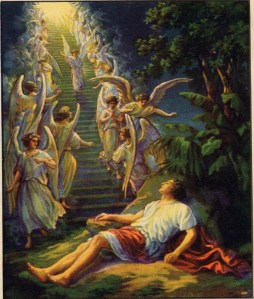
“Then he dreamed, and behold, a ladder was set up on the earth, and its top reached to heaven, and there the angels of God were ascending and descending on it.” Gen. 28:12

“And He said to him, ‘Most assuredly I say to you, hereafter you shall see heaven open, and the angels of God ascending and descending upon the Son of Man.’” John 1:51

Read Genesis 28: 10-22 and John 1:43-51

In Genesis we see that man was created with the intent of communication with his Creator. Adam walked with God in the cool of the day. There was nothing to hinder their relationship. What must that have been like? Yet, when sin entered the world, that communication was altered. Adam could not just approach God at any time and in any way.

Fast forward a few thousand years. God has made a covenant with Noah, with Abraham and with Isaac. Now He comes to Jacob in a dream. He dreams of a ladder between Heaven and earth, with angelic beings travelling up and down on it. The ladder was NOT symbolizing the commandments of God, that if we were able to keep them, we could get to Heaven. The tower of Babel was man’s attempt to reach God with their works. God put an end to that idea pretty quick.

It is a beautiful symbol of mediation and reconciliation. It re-establishes communication. Jacob is able to communicate with God. The messengers pass on errands of mercy. Martin Luther says, “The dear angels take our prayers to heaven and bring back the answers.”

This ladder was a means of communication between Heaven and earth. Heaven and earth have been separated by sin. The LORD is above, and Jacob, the object of His mercy, is beneath.

The ladder points to the God-Man who reunites Heaven and earth. Matthew Henry says, “We have no way of getting to Heaven but by Christ.” He also says that the ladder represents the two natures of Christ. The top of the ladder His divine nature, and the bottom rung, His human nature.

In John 1: 51 Jesus presents Himself as the reality to which the stairway pointed. Jacob saw the dream of a union between Heaven and earth; Christ made it a reality. He also compares Jacob the deceiver, also called Israel, to Nathaniel, “an Israelite indeed, in whom is no deceit. “ What Nathaniel would witness in the fulfillment of this symbol would be far superior to Jacob’s vision. He would witness the true ladder, the true communication from Heaven, the true Mediator between God and man, and as a believer he would be part of the true Israel, the family of believers throughout history.

Through Christ, the only Mediator between God and men (1 Tim. 2:5) we have access to the Father (Eph.2:8). Matthew Henry says, “Christ is the Way all God’s favours come to us, and all our services go to Him.”

Prayer-“Lord, thank You for not leaving us as we were, unable to approach You, unable to communicate with You or hear what You had to say to us. Thank You for being the ladder between Heaven and earth, so that we could approach you by faith and be welcomed into the family of God; the true Israel.”

Questions-How did you understand Jacob’s ladder? Did you think it was works or representative of Christ?

Response-In prayer, we communicate with God. In reading and hearing God’s word, He communicates with us. How has your communication been lately? Do you avail yourself of this incredible privilege of communicating with the God of the Universe Who has loved you with an everlasting love? Spend time with Him today.

Solomon’s Life as a Type of Christ in 1 Kings

17 Nov

Read 1 Kings 1-11

In the glory days of Israel, King Solomon stood out. Although his father, David was revered as the best king, unlike David’s reign, Solomon’s reign knew mostly peace. He was also the wealthiest king, and the wisest man who ever lived, apart from Christ. We will look at the ways that the whole life of Solomon pre-figured Christ, both by similarities and contrasts.

Solomon was the King of Israel. Then Solomon sat on the throne of his father David; and his kingdom was firmly established.” 1 Kings 2:12

Jesus Christ is the King of Kings. “And He has on His robe and on His thigh a name written: KING OF KINGS AND LORD OF LORDS.” Rev. 19:16

Solomon’s kingdom knew a time of unprecedented peace. This peaceful reign foreshadowed the time of peace that will never end.1 Kings 4:24,25

This time of peace eventually ended. See 1 Kings 11:14,23,26 but Christ’s reign will know no end. Christ is the Prince of Peace. Isaiah 9:6,7

Solomon was rich, with yearly tax revenue equalling 39,960 pounds of gold. 1 Kings 10:14 (See all of 1 Kings 10 ) He had an opulent palace and many building projects, the pinnacle of which was Solomon’s temple. Read 1 Kings 6:14-22

But Jesus Christ is rich, without taxing His people. “For every beast of the forest is Mine, And the cattle on a thousand hills.” Psalm 50:9-11 Psalm 50:11-13

He is the maker and owner of all things. Thus says the LORD: Isa. 66:1-3 And He owns the gold and silver in every mine.Hagg.2:8

Yet, Jesus laid aside His glory and riches for our sake. “For you know the grace of our Lord Jesus Christ, that though He was rich, yet for your sakes He became poor, that you through His poverty might become rich.” 2 Cor. 8:8-10 In what sense did He become poor? On earth, He was homeless, had only one piece of clothing worth anything, and had no possessions. He owned no property and carried no cash. He even paid His taxes in an unusual way.  “Nevertheless, lest we offend them, go to the sea, cast in a hook, and take the fish that comes up first. And when you have opened its mouth, you will find a piece of money; take that and give it to them for Me and you.”Matthew 17:27

When the Queen of Sheba came to investigate the rumours about Solomon’s wisdom and wealth, she exclaimed,   “It was a true report which I heard in my own land about your words and your wisdom. However I did not believe the words until I came and saw with my own eyes; and indeed the half was not told me. Your wisdom and prosperity exceed the fame of which I heard! 1 Kings 10:6,7” We cannot begin to imagine how amazing Heaven will be.

She said his servants were blessed to see his face and hear his righteous judgments. “Happy are your men and happy are these your servants, who stand continually before you and hear your wisdom! Blessed be the Lord your God, who delighted in you, setting you on the throne of Israel! Because the Lord has loved Israel forever, therefore He made you king, to do justice and righteousness.” 1 Kings 10:8,9

Even more so, the servants of Christ are blessed to read His words and serve Him. God is praised because He delighted in His Son and was pleased to set Him on the throne of the universe, to do justice and righteousness. One day, we will see Him face to face, hear His voice, and serve Him without weariness or sin.  And there shall be no more curse, but the throne of God and of the Lamb shall be in it, and His servants shall serve Him. They shall see His face, and His name shall be on their foreheads.” Rev.22:3.4

Solomon received wisdom from God so that he could lead Israel. One case in particular stands out. Read 1 Kings 3:16-28 Two women and one live baby that they both claimed was theirs. Solomon’s decision revealed the true mother.  And all Israel heard of the judgment which the king had rendered; and they feared the king, for they saw that the wisdom of God was in him to administer justice.” 1 Kings 3:28

Jesus teaching was unlike any other. He spoke with authorityAnd so it was, when Jesus had ended these sayings, that the people were astonished at His teaching, for He taught them as one having authority, and not as the scribes.”Matt.7:28,29 He forgave sin. He passed judgment. When Jesus had raised Himself up and saw no one but the woman, He said to her,’Woman, where are those accusers of yours? Has no one condemned you?’She said, ‘No one, Lord.’And Jesus said to her, ‘Neither do I condemn you; go and sin no more.’” Matt. 8:10,11

When questioned about paying taxes, And Jesus answered and said to them, ‘Render to Caesar the things that are Caesar’s, and to God the things that are God’s.’ And they marveled at Him.” Mark 12:17

When Solomon ascended to the throne, he destroyed his enemies; Adonijah, Abiathar, Joab and Shimei.

Adonijah, his brother, for his attempted coup. 1 Kings 1:5 The King would not tolerate rivals.

Abiathar, the priest, was exiled, because he supported Adonijah’s grab for the throne. 1 Kings 1:7  1 Kings 2:26,27

Joab was executed for his support of Adonijah  (1 Kings 1:7) and for his peacetime murder of two generals.1 Kings 2:5,6 1 Kings 2:31-33

Shimei was exiled, and later executed for breaking the terms of his exile. His crime is found in 2 Samuel 16:5-131 Kings 2:44-46

In relation to Shimei, Solomon showed mercy by not destroying him right away and by warning him. Christ, in relation to sinners does not always punish right away, and shows mercy by warning them of coming punishment.

Thus Solomon’s kingdom was established when he put away his mortal enemies. Likewise, when we acknowledge the Kingship of Jesus Christ, we put him first. There is nothing we want more. We seek His kingdom first.But seek first the kingdom of God and His righteousness, and all these things shall be added to you.” Matthew 6:33

Christ also ascended to Heaven, and is seated at the right hand of Majesty on high, having destroyed the power of the grave and hell forever.

 “ ‘O Death, where is your sting?]O Hades, where is your victory?’[The sting of death is sin, and the strength of sin is the law. But thanks be to God, who gives us the victory through our Lord Jesus Christ.” 1 Cor. 15:55-57

For He must reign till He has put all enemies under His feet. The last enemy that will be destroyed is death.” 1 Cor. 15:25,26

“He who sins is of the devil, for the devil has sinned from the beginning. For this purpose the Son of God was manifested, that He might destroy the works of the devil.” 1 John 3:8

“I am He who lives, and was dead, and behold, I am alive forevermore. Amen. And I have the keys of Hades and of Death.” Rev. 1:18

Inasmuch then as the children have partaken of flesh and blood, He Himself likewise shared in the same, that through death He might destroy him who had the power of death, that is, the devil,  and release those who through fear of death were all their lifetime subject to bondage.” Heb. 2:14,15

By destroying his enemies, Solomon did not tolerate threats to his reign or false claims to his throne. Likewise, Our God is a jealous God and He will not give His glory to another. He is the Only One worthy to sit on the throne and judge the nations.

“Worthy is the Lamb who was slain to receive power and riches and wisdom, and strength and honor and glory and blessing. And every creature which is in heaven and on the earth and under the earth and such as are in the sea, and all that are in them, I heard saying: ’Blessing and honor and glory and power Be to Him who sits on the throne, And to the Lamb, forever and ever!’” Rev.5:12,13

Solomon built a magnificent temple, seven years in the making, with many objects made of marble and overlaid with gold. It was one of the wonders of the ancient world.

Jesus Christ has been preparing a place for us in Heaven for 2,000 years! How awesome will that be? We will walk through gates of pearl, stroll on streets of gold, and live in a city whose foundations are made of precious stones.  Rev.21 and 22

In My Father’s house are many mansions if it were not so, I would have told you. I go to prepare a place for you.And if I go and prepare a place for you, I will come again and receive you to Myself; that where I am, there you may be also.” John 14:2,3

After Solomon finished building the temple, during the dedication, God Himself came to dwell in it. “And it came to pass, when the priests came out of the holy place, that the cloud filled the house of the Lord,  so that the priests could not continue ministering because of the cloud; for the glory of the Lord filled the house of the Lord.” 1 Kings 8:10,11

Likewise, God ‘tabernacled’, or pitched His tent among us, when Christ took on flesh and lived among us. And the Word became flesh and dwelt among us, and we beheld His glory, the glory as of the only begotten of the Father, full of grace and truth.” John 1:14

But even more glorious, will be the day when we will be in the presence of God in Heaven, seeing His face, enjoying unbroken fellowship with Him.“”And I heard a loud voice from heaven saying, ‘Behold, the tabernacle of God is with men, and He will dwell with them, and they shall be His people. God Himself will be with them and be their God.  And God will wipe away every tear from their eyes; there shall be no more death, nor sorrow, nor crying. There shall be no more pain, for the former things have passed away.’” Rev. 21:3, 4

In the book of Song of Solomon, the king is a lover. Christ is the lover of our souls. The king is the fairest of ten thousand. Jesus is the name above every name.

“Therefore God also has highly exalted Him and given Him the name which is above every name, that at the name of Jesus every knee should bow, of those in heaven, and of those on earth, and of those under the earth,  and that every tongue should confess that Jesus Christ is Lord, to the glory of God the Father.” Philippians 2:9-11

The lover sees his bride as perfect and beautiful. “You are all fair, my love, And there is no spot in you.” Song of Solomon 4:7 Christ sees His bride that way as well. “…that He might present her to Himself a glorious church, not having spot or wrinkle or any such thing, but that she should be holy and without blemish.” Ephesians 5:27

Solomon had a legitimate claim to the throne as the son of David. Also, it is significant that he was a child conceived after David married Bathsheba, so no one could say Solomon was illegitimate. Adonijah was the eldest, so he assumed  he was next in line for the throne. However, God had promised that David’s son, Solomon would sit on the throne. “Behold, a son shall be born to you, who shall be a man of rest; and I will give him rest from all his enemies all around. His name shall be Solomon,for I will give peace and quietness to Israel in his days.  He shall build a house for My name, and he shall be My son, and I will be his Father; and I will establish the throne of his kingdom over Israel forever.’” 1 Chronicles 22:9,10

Jesus Christ also has a legitimate claim to the throne of David and the throne of the universe. If you look at the genealogies you’ll see He is in the family line of David. But as the Son of God He has the right to sit on the throne of Heaven.“For David did not ascend into the heavens, but he says himself:‘The Lord said to my Lord,‘Sit at My right hand, Till I make Your enemies Your footstool.’” Acts 2:34,35

Solomon did not remain true to the end. For it was so, when Solomon was old, that his wives turned his heart after other gods; and his heart was not loyal to the Lord his God, as was the heart of his father David. For Solomon went after Ashtoreth the goddess of the Sidonians, and after Milcom the abomination of the Ammonites. Solomon did evil in the sight of the Lord, and did not fully follow the Lord, as did his father David.Then Solomon built a high place for Chemosh the abomination of Moab, on the hill that is east of Jerusalem, and for Molech the abomination of the people of Ammon.And he did likewise for all his foreign wives, who burned incense and sacrificed to their gods.”1 Kings 11:4-8 A true tragedy. It started early with his political marriages to unbelievers. Spiritual change always happens little by little. Mark Dever says, “A small difference in trajectory can make a big difference in destination.”

Yet Christ is called “Faithful and True” Rev.19:11 He is also, “the Way, the Truth, and the Life.” John 14:6 He finished the work the Father gave him to do and did not shrink back from it.

Solomon’s house and temple were magnificent, but they were eventually ransacked, rebuilt and eventually destroyed. His glory was temporary. He reigned only 40 years, then went the way of all the earth. 1 Kings 11:42,43

But Christ’s glory is eternal and His reign will know no end. “And every creature which is in heaven and on the earth and under the earth and such as are in the sea, and all that are in them, I heard saying: ‘Blessing and honor and glory and power Be to Him who sits on the throne,
And to the Lamb, forever and ever!’”
Rev.5:13

Epitaph

So what happened to Solomon? Can we expect to see him in Heaven one day?

I believe there is reason to be hopeful for several reasons.

First, God showed mercy in the midst of judgment. Divine judgement was deferred.“Therefore the Lord said to Solomon, “Because you have done this, and have not kept My covenant and My statutes, which I have commanded you, I will surely tear the kingdom away from you and give it to your servant.Nevertheless I will not do it in your days, for the sake of your father David; I will tear it out of the hand of your son.However I will not tear away the whole kingdom; I will give one tribe to your son for the sake of My servant David, and for the sake of Jerusalem which I have chosen.” 1 Kings 11:11-13 However I will not take the whole kingdom out of his hand, because I have made him ruler all the days of his life for the sake of My servant David, whom I chose because he kept My commandments and My statutes.” 1 Kings 11:34

God promised that He would discipline David’s son but not cast him off forever, as he did Saul.

 “’When your days are fulfilled and you rest with your fathers, I will set up your seed after you, who will come from your body, and I will establish his kingdom. He shall build a house for My name, and I will establish the throne of his kingdom forever. I will be his Father, and he shall be My son. If he commits iniquity, I will chasten him with the rod of men and with the blows of the sons of men.But My mercy shall not depart from him, as I took it from Saul, whom I removed from before you. And your house and your kingdom shall be established forever before you. Your throne shall be established forever.’”2 Sam 7:12-16

If the book of Ecclesiastes is any indication of his mindset, he seemed to “get it” in the end.

“Let us hear the conclusion of the whole matter: Fear God and keep His commandments,
For this is man’s all.For God will bring every work into judgment, Including every secret thing,
Whether good or evil.”
Ecc. 12:13,14

In the book, King Solomon: The Temptations of Money, Sex and Power, Phillip Graham Ryken concludes, “Solomon was one of the greatest men who ever lived. He came from noble birth, heir to the world’s most famous dynasty. He was the king of Israel. He had a powerful army and cavalry, but never needed to use it as he ruled during a golden age of peace. During Solomon’s reign the kingdom grew to its widest expanse.  He had riches beyond compare. He was a famous builder. His temple in Jerusalem was one of the wonders of the ancient world. He was an accomplished naturalist and a learned scholar, a brilliant poet and philosopher. He was a man of prayer. (See his prayer at the dedication of the temple in 1 Kings 8:22-53). Above all he was a man of wisdom. His kingdom reveals a pattern for the kingdom of Jesus Christ.”

The queen of the South will rise up in the judgment with the men of this generation and condemn them, for she came from the ends of the earth to hear the wisdom of Solomon; and indeed a greater than Solomon is here. Luke 11:31

Prayer: “Thank  you, Lord, for the life of King Solomon. You blessed him beyond measure and gave us a glimpse of the future glory of your kingdom. You are wiser, more glorious, richer, more merciful than he was. We are blessed as your servants to hear Your words and learn from You. One day we will see you face to face in the home You’ve been preparing for two thousand years. We will serve and worship You forever.”

Questions: Solomon took seven years to build the temple of God and thirteen years to build his own house? What does that reveal about his heart? What is the ratio of time/money spent on kingdom work vs. our own homes? What does that reveal about the state of our hearts? What were some of the small choices that Solomon made that ended in tragedy? Do you feel more hopeful that we will see Solomon in Heaven, after this study?

Response: The Queen of Sheba gave full honour to Solomon, and he wasn’t half the king Jesus is. Do we honour Him as we ought?

Melchizedek as a Type of Christ in Genesis

27 Oct

Read Genesis 14:18-20, Psalm 110:4, Hebrews 5:5-11,7
Christ is referred to as having three offices; Prophet, Priest and King. In what sense is He a priest? As a priest, He represents men to God, and God to men. He offers sacrifices. He serves God. He mediates between God and man in their covenant.
Christ was, humanly speaking, from the tribe of Judah. It was the Levites who were the priestly line. In fact, any time a king tried to take on the priestly role, they were rebuked and removed. (i.e. Saul and Uzziah) According to the law of Moses, a king could not be a priest and a priest could not be a king.
How then could Jesus be a priest and a king?
In Genesis 14, we’re introduced to a person named Melchizedek, who is referred to as a priest of God Most High and king of Salem (Jerusalem/Shalom/Peace). Melch means king and zedek means righteousness. He meets Abraham as he is returning from a military victory. Abraham, the patriarch recognizes Melchizedek as his superior, and gives him a tenth of his spoils. Some comment on the tenth as a tithe even before the law was given, which may or may not be significant. He also gave him bread and wine, which may foreshadow the Lord’s supper, and Christ’s sacrifice of His body and blood, although they aren’t mentioned in that context in the New Testament. They were common staples. He was basically bringing nourishment to the troops.
The verse seems to be plopped into the narrative in an odd place. But perhaps it was to remind Abraham that it was God who gave him the victory, since right after that, the King of Sodom offered him the spoils of war, which he refused.
Melchizedek seems to come from nowhere. In a book known for long lists of genealogies, the lack of information about him is significant. That’s one reason some believe He was a theophany, a pre-incarnate appearance of Christ, which we see in several other places in the Old Testament. However, there’s no indication that Abraham recognized him as such, and all treatments of this section in other parts of Scripture don’t approach it that way.
Psalm 110 is another place where Melchizedek is mentioned. This psalm is the most quoted verse in the New Testament. This verse, like the one in Genesis 14, also seems to have been dropped into the psalm. This psalm is widely accepted as being a Messianic psalm, meaning it was prophesying about the coming Messiah. It describes an enthroned priest-king setting out in conquest of the world.
“The LORD has sworn
And will not relent,
‘You are a priest forever
According to the order of Melchizedek.’” Psalm 110:4
David is implying that the Levitical priesthood is not good enough; it must be eclipsed. The law and the priesthood are tied together, so that if you take away one, then the other must go too.
“Therefore, if perfection were through the Levitical priesthood (for under it the people received the law), what further need was there that another priest should rise according to the order of Melchizedek, and not be called according to the order of Aaron?” Hebrews 7:11
D. A. Carson says sequence matters. In Genesis 14 Abraham encounters Melchizedek, a priest-king before the law is given. Half a millennium later, the law states that the king and priest cannot be the same person. David then says there will be a priest-king, making the law in principle obsolete. Then Hebrews says we have a priest-king from the tribe of Judah, making the law and old covenant obsolete.
It’s only when we get to the New Testament that some light is shed on exactly how Christ is like Melchizedek. Hebrews 7:3 says that Melchizedek was “without father, without mother, without beginning of days or end of life, but made like the Son of God, remains a priest forever”.
This makes it sound either like he is a theophany of the eternal Son of God, or merely a reference to his appearance out of obscurity. He shows up in one scene in Scripture and then disappears just as quickly. We know nothing else about him, unlike all other important persons throughout Scripture.
So, how is Christ like Melchizedek?
“Christ was ‘without father as relates to His humanity, and without mother as relates to His divinity.” B.B.Warfield
Further, without beginning or end of days in relation to Melchizedek means we don’t know anything about his lifespan. There is no mention of how long Melchizedek lived, as you also see in the genealogical lists. To the Jew, and then for our sake, it was important to know which family line someone descended from. It was how we would recognize the Messiah, who would be from the family line of Judah, and then a descendant of David.
In relation to Christ it refers to His eternal Sonship. As God, He had no beginning and He will have no end. He is the eternal God, the Ancient of Days, the Alpha and Omega, the Beginning and the End. He lived before the stable in Bethlehem and will exist forever.
As such, His priesthood is far superior to the Levitical priesthood. Those priests could only continue for a while, because death eventually overtook them.
But Christ, who is the eternal Son can be a Priest forever, because He will never die. He can continue to be the Mediator between God and man, making intercession for us because of the sacrifice of Himself, making atonement for us with His blood.
Also, King of Salem, means King of peace (Heb. 7:2). Salem was an early name for Jerusalem. Christ is both the King of the Jews and the Prince of Peace (Isa.9:6). He gives peace in our hearts because we have peace with God. “…having made peace through the blood of his cross.” Col.1:20

Prayer– “Thank you for being my everything, Jesus. You are the King of the Universe and yet you rule in my heart, as a Prophet, You tell me in Your word what the kingdom of Heaven is like and You teach me how to live for You. As a Priest, You represent God to me, so I worship You, and You mediate for Me before the throne of Heaven. Thank you that you are eternally my priest forever because of who You are.”

Questions-Do you realize you need a priest? Not an earthly one, but a perfect One? This One sacrificed Himself so that His blood could cover your sin. He also mediates between you and God the Father. (see the blogpost on Christ as the Mediator in Job).

Response-Thank God for being a far superior priest to the types and shadows of the past.

Jesus as the Judge of All the Earth in Revelation

20 Oct

Read Revelation 20:11-15

Maybe I have an overly sensitive conscience, but I feel nervous around police and judges. Once, when I was called for potential jury duty, I took the stand to be asked a simple question. My heart was racing. I was sooooo  nervous! If I tremble before a human judge even though I’m innocent, what would it be like to stand before the Judge of all the earth, guilty?

The images of the end of the age are awesome, with horrible judgments poured out on the earth, and a vision of God on His throne so terrible, it says the earth and heaven fled away, and there was no place for them. (Rev. 20:11) People will be so terrified, they will prefer to hide in caves and ask the mountains to fall on them and hide them from the wrath of the Lamb. “For the day of His wrath has come, and who can stand?” Rev.6:14-17

One doesn’t usually associate wrath with a lamb. Lambs are docile, sweet and helpless. But this Lamb, who “as a sheep before her shearers is silent, so he did not open his mouth.” Isa.53:7, was also, “Christ, our Passover, slain for us.” 1 Cor.5:7 The Lamb of God came to earth the first time to handle the sin problem. Now He is coming to Judge the earth.

In Matt. 25:31-46, Jesus tells a parable about the Sheep and the Goats. It is set at the Last Judgment. Jesus is on the throne. We know this because the One on the throne refers to His Father. Also, we know that all judgment has been committed to the Son. John 5:22, Rom.2:16, Eph. 5:10, john 5:22

The sheep and goats are separated, with the sheep on the right and the goats at His left hand. Jesus here rewards His people for doing things out of love for Him. They are so unaware of their actions being commendable, that they are surprised to hear that He likens their good works to His brethren as good works toward Him, personally.

Also notice, He rewards His people first, in order to vindicate them before the unbelieving world. It’s amazing to me that He would equip us for good works, Eph.2:10, and then reward us for them. 1 Cor. 3:14,15 Good reason to cast our crowns before Him. Rev.4:10

Then He assigns the unbelievers to eternal torment using almost the same words He uses to praise the sheep. They also protest, claiming innocence that it was Jesus they failed to care for when they failed to care for “the least of these”. They were looking to get off on a technicality, but God knows their hearts.

The images in the last few chapters of Revelation are sobering. Read Rev. 20:11-15 again. You see the awesomeness of the One on the Great white throne, the reanimation of the dead from the sea and the graves, all standing now before the Judge. Books will be opened, and people will be judged “from the things which were written in the books, according to their deeds.” Rev. 20:12

The most important book seems to be the Book of Life. “And if anyone’s name was not found written in the book of life, he was thrown into the lake of fire.” Rev. 20:15

I know everyone has a different story to tell about how they were saved. Some see the beauty of the gospel, some see the reasonableness of it, some see the awesome sacrifice of Christ. I feared judgment. I recognized, even as a child, that I was guilty, and that God would be just in condemning me to hell. When I heard the good news, that He had also provided a way to escape the judgment, I ran for it.

That’s not a bad thing. It’s one approach to preaching the gospel. “…some save with fear…” Jude 1:23 The good news isn’t good news unless we first hear the bad news. How can we have assurance of our salvation and confidence that we can stand before the throne of this Awesome One without fear? The answer definitely doesn’t rest in us. I can’t “keep” myself in the faith, any more than I got myself into it. Salvation is God’s work from start to finish. He is the “Author and Finisher of our faith.”  Heb. 12:2 He chose me, so He keeps me. (Rom. 8:29). They are links of the salvation chain, we are secure because of Christ.

There are many theological terms we read in our Bibles, without really understanding them: justification, sanctification and propitiation come to mind. Most believers get the general idea of those words, but couldn’t give a clear definition.

We’ll focus on justification for a moment. I’ve heard that it means God looks on you “just-as-if-you-had-never-sinned”. While it might be a helpful way to remember, I think it’s a weak definition. Justification is actually a legal term. Since we’re dealing with the Supreme Court of the Universe, it’s helpful to speak legal-ease. Justification, as it is used in the Bible, primarily means to be declared righteous. That is exclusively the idea that the Apostle Paul means. James uses the term, but he uses it in reference to how our works validate our faith in the eyes of men, not how we stand or fall before God.

Justification differs from sanctification, which is the process by which God progressively makes us holy. The first thing we need is to have the death sentence removed from over our heads. When we believe in Jesus Christ; repenting of our sin and resting in the finished work of Christ as our Substitute, God declares us “NOT GUILTY”. We are free! “And Abraham believed God, and it was counted to him as righteousness.” Gen.  15:6 and Rom.5:1,2, Rom.8:1

As the Judge of the earth, He has the right to do that; to let a guilty person go free. But as a holy and just God, He could not do that without going contrary to His nature, which He cannot do. “He cannot deny Himself.” 2 Timothy 2:13 If only there was a way……….There is a way! His name is Jesus. Because Jesus was our Substitute, who paid in full for our sin, God can legitimately justify us.

So when we flee to Jesus for safety, we are hidden in Him, and in that sense, God now looks on us “just-as-if-we-had-never-sinned”. When God the Father sees us hidden in Christ, He sees only the perfect righteousness of His son. Col.3:3 A great exchange has taken place. Our sins on Christ, Christ’s righteousness imputed, or made over, to our account. O sweet exchange!

Justification by faith alone is a beautiful, life-changing, uplifting, soul-assuring doctrine. Never tire of praising God for justifying you. Because you are justified, you will not be condemned on that awful day. The worst words anyone will ever hear will be, “Depart from Me. I never knew you.” Matt.7:23

Yet, “there is therefore now no condemnation to those who are in Christ…” Rom.8:1

“It is in the substitutionary death of Christ that sin is overcome and wrath is averted, so that God can look upon man with pleasure, and man can look upon God without fear. Sin is expiated and God’s wrath is propitiated.” John Stott

Prayer– “Lord, how awesome You are. You are our Creator and our Saviour. The truth of a future judgement would be terrifying, if we weren’t secure in Christ. ‘Thank you’ is so inadequate to express our feelings about saving us from hell and promising us Heaven. +Help us to share the gospel so that others won’t have to face the wrath of the Lamb.”

Questions– When we stand before Jesus, will He be our Saviour or our Judge? If you are unsure, spend some time in prayer, asking God to save you, or if you are saved, to give you assurance of your salvation, so you don’t need to fear death and judgement. –Was fear of judgement a factor in your conversion?

Response– How familiar are you with theological terms? Look up the meaning of the following terms: justification, sanctification, adoption, redemption, propitiation.

Christ as the Blood of Abel in Genesis

29 Sep

Read Genesis 4:1-15

Sadly, we see the effects of the fall of Adam and Eve already in the next generation, where the first murder is recorded. Poor Abel is mentioned in this chapter only for his birth, his offering and his death. His birth is recorded in verse two and his murder in verse eight. He is mentioned in several other places in Scripture, though. It’s there that we get a commentary of what went on here in Chapter Four.

“By faith Abel offered to God a more excellent sacrifice than Cain, through which he obtained witness that he was righteous, God testifying of his gifts; and through it he being dead still speaks.” Heb. 11:4

Jesus also referred to him as “righteous Abel”.

“…that on you may come all the righteous blood shed on the earth, from the blood of righteous Abel to the blood of Zechariah, son of Berechiah, whom you murdered between the temple and the altar.” Matt.23:35

Abel is both a type of the true believer and a shadow of Christ.

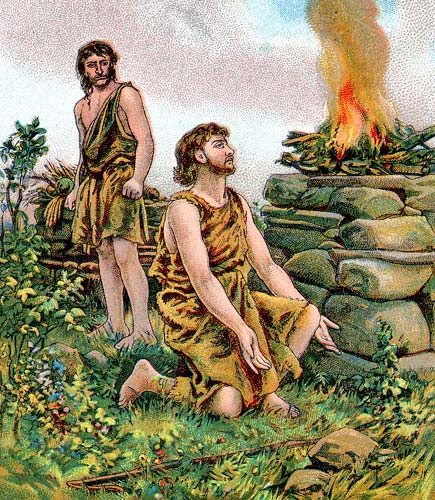
He is a type of the true believer because of his offering and his faith. He brings an offering of “the firstborn of his flock, and their fat.” This represents the first and best, as fat was considered the best part of an animal. We also know the animal was slain, or else they could not get the fat. So a blood sacrifice is implied. Abel did this in faith, seeing the lamb as his substitute before God, until the Promised Seed would come.

Cain, by contrast, brought “an offering”. He came with neither his firstfruits nor his best. He came with the work of his hands, thinking he could approach God his own way, rather than the way God prescribed. Cain and Abel would have learned from the example and teaching of their parents, that God must be approached by faith and with blood. This was their first expression of faith and dependence on God as adults.

God sees the heart. It wasn’t just the type of sacrifice that was a problem, but the attitude. The offering and the worshipper are inseparable. When God appeals to Cain in mercy, Cain gets angry. He had no reason to be angry, and he could still make it right. Cain was envious. He takes his brother out to a field where he thinks no one will see them, and kills him. He should have loved him because he was his brother, and even more so, protected him as a younger brother. Instead we see,

“…not as Cain who was of the wicked one and murdered his brother. And why did he murder him? Because his works were evil and his brother’s righteous.” 1 John 3:12

God asks, “Where is Abel, your brother?”  I find this interesting; as if there was any other Abel in town. God does this to emphasize the heinous nature of the crime and to strike at Cain’s conscience.  Cain lies. “I do not know,” as if he could conceal his crime. Then he goes further with a surly response which questions the right of the Almighty to even ask. “Am I my brother’s keeper?” His response reveals his hard heart and a lack of any natural brotherly affection.

“And He said, ‘What have you done? The voice of your brother’s blood cries out to me from the ground.’” Gen. 4:10

This shows God’s outrage. Remember, God never asks a question to get information. He knows all things. He asks, as a parent would, to see if Cain will confess and repent. Just as earlier, He asked, “Adam, where are you?”

Cain complains that his punishment is greater than he can bear. He is not sorry for his sin, only sorry he got caught. He fears a violent death, like his brother. Even so, God again shows mercy to him by delaying the sentence of death already over his head because of the disobedience of his parents.

Matthew Henry says, “It shows great hardness of heart to be more concerned about our sufferings than our sins.”

Abel is also a shadow of Christ because Abel’s sacrifice is imperfect, whereas Christ’s is perfect. “Not with the blood of goats and calves, but with His own blood He entered the most holy place once for all, having obtained eternal redemption.” Heb. 9:12

He is also a shadow because of the contrast between the intent of the blood of Abel vs. the blood of Christ. Abel’s blood cries for vengeance, but Christ’s blood cries for forgiveness.

“…to Jesus the Mediator of a new covenant, and to the blood of sprinkling that speaks better things than that of Abel.” Heb. 12:24

Because of Christ’s death, we can enter the presence of God, from which our first parents were banished. “Therefore, brethren, having boldness to enter the Holiest by the blood of Jesus…” Heb. 10:19

“Jesus is the true and better Abel who, though innocently slain, has blood now that cries out, not for our condemnation, but for acquittal.”
Timothy Keller

Prayer-“Lord, forgive me for trying to approach You my way, with the works of my hands, as if that would be acceptable. You have provided the best way through Your Son. Thank you that His blood covers my sin and cleanses me from guilt. Thank You for Your great forgiveness.”

Questions-Do you feel envious of someone else’s ministry? Why do you think you have that attitude?

Response-Thank God for the sufficiency of His sacrifice that allows you to enter His presence with boldness.

Christ as the Kinsman-Redeemer in the Book of Ruth

15 Sep

Read Ruth 1-4.

The Bible has a bit of everything in it. There is history, biography, poetry, prose, apocalyptic, and even romance. The book of Ruth is a romance novella which plays an important part in redemptive history. God could have just thrown a couple together in an arranged marriage and the family line of Christ would have continued on. Yet he chose to give us a glimpse into the character of a young Gentile woman, in order to give hope to those of us outside of the nation of Israel.

Boaz was a wealthy businessman in Bethlehem; he was powerful and important in society. He was older than Ruth by at least twenty years. He is impressed by Ruth as she works in the field, hearing a good report of her by his foreman. He has heard of her actions in following Naomi to a strange country. He may have thought of his ancestor, Rahab, who was also a stranger in Israel.
Although he is impressed by her and may even be attracted to her, he doesn’t pursue her as, undoubtedly, he feels their age difference is too great. If it were not for Naomi’s meddling and Ruth’s willingness to do as Naomi instructed her, Boaz may never have made a move. When Ruth approaches him the night on the threshing floor and basically proposes to him, he is very humble, not even acknowledging that he is quite an eligible bachelor. Instead, he commends her for not running after the young men. He guards her reputation the night on the threshing floor by sending her away while it is still dark, lest someone assume something happened between them, and then he gives her grain to take with her in case someone was to inquire where she was at that hour.

The Scarlet Thread in this story is Boaz as a kinsman-redeemer. The idea of the Kinsman-Redeemer is that a near relative can redeem, or buy back the property of a relative who had been forced to sell their land for some reason, and now they cannot buy it back themselves because they are impoverished . These laws were in place to ensure that family members are looked after and the land stays in the family. See Deut. 25:5-10 and Mark 12:18-25

The two main requirements of a Kinsman-Redeemer are that he must be 1) qualified to redeem, (a close relative who could afford to buy the land) and 2) willing/able to redeem (not already married). It was voluntary. There was a way out, although it was frowned upon. (See Deut. 25:7-10) He was spit upon and lost his sandal. It was scandalous/he was sandal-less!
Boaz is a wonderful example of a Kinsman-Redeemer who is both qualified and willing. He has a nature that is unselfish and nurturing. He comes to the rescue. He shows great kindness to Ruth. He protects her and provides for her.

He remembers there is another relative who was closer than he who could end up married to Ruth instead of him, was qualified to be a kinsman-redeemer. This is the conflict, or complicating factor you see in all great romances. How will they overcome it? Will our hero and heroine find true love? Thankfully, he was unwilling. He was too selfish. He didn’t mind inheriting Elimelech’s property, he just hadn’t counted on a wife in the deal. As well, their first son would not bear his name. He would also share the inheritance. It was all too much trouble. Boaz tells Ruth he’ll approach the other relative, so she doesn’t have to humble herself by proposing to someone else. He also indirectly promises to care for Naomi as well.
This transaction, done at the “city gates” where all business was transacted before witnesses, was done properly, so there would be no question as to the legitimacy of Boaz’s claim to Ruth and the inheritance of Elimelech. Although it sounds like Ruth is ‘purchased’ in a business transaction, you see from the interaction between them, that Ruth and Boaz do really love each other.

When he first met Ruth one of the things he said to her was, “The LORD repay your work, and a full reward be given you by the LORD God of Israel, under whose wings you have come for refuge.” Ruth 2:12 When she approaches him about marriage, she uses his own words and images back to him to show how he can help her practically and bless her and be the answer to her prayer. “Take your maidservant under your wing, for you are a close relative.” Ruth 3:9

This reminds us of the idea of Eve being made from Adam’s rib. Matthew Henry has a great quote that’s nice for weddings.

“The woman was made of a rib out of the side of Adam;
not made out of his head, to rule over him;
nor out of his feet, to be trampled upon by him;
but out of his side to be equal with him;
under his arm to be protected,
and near his heart, to be beloved.”

To draw out the Scarlet Thread in this narrative, we see Christ as our Kinsman-Redeemer. He is like Boaz because he “owns the field” and marries one who was formerly a stranger and foreigner who puts her trust in Him and becomes His bride. Christ is even better than Boaz as a Kinsman-Redeemer. We are destitute spiritually, with no way to get out of debt and no way to provide for our eternal well-being. Christ steps up. He is our kinsman, one who is like us, who is our friend, who sticks closer than a brother. He is qualified. He is able to redeem.

He sees our situation and is moved with compassion. Compassion has the idea of suffering together. But he did more than that. He doesn’t merely feel a sad situation and feel pity for us. He does something about it. This is AGAPE love; love in action.

He set aside His royal robes and willingly condescended to become one of us. Then He lived a perfect life that we could not, died a sacrificial death to pay a debt He did not owe and we could never repay. Having accomplished our Redemption, our ‘purchase’, He ratified it by rising from the dead. He has purchased His people. Like Boaz’s official transaction at the gates of the city, so Christ purchased His bride publicly when He died on the cross. “This thing was not done in a corner.” Acts 26:26 By purchasing us and bringing us into His family, He saved us from destruction.

We are no longer destitute. We are heirs, co-heirs with Christ, and He owns all things. He is our Bridegroom. He has purchased His Bride, “…knowing that you were not redeemed with corruptible things, like silver or gold, from your aimless conduct received by tradition from your fathers, but with the precious blood of Christ, as of a lamb without blemish and without spot.” 1 Pet. 1:18,19

“Do not fear, for you will not be ashamed;
Neither be disgraced, for you will not be put to shame;
For you will forget the shame of your youth,
And will not remember the reproach of your widowhood anymore.
For your Maker is your husband,
The LORD of hosts is His name;
And your Redeemer is the Holy One of Israel;
He is called the God of the whole earth.” Isaiah 54:4,5
This story is another example of a situation where we wonder if people are going to mess up the plan of God, like Judah could have by going to Canaan and marrying a Canaanite woman, or like Elimelech and Naomi could have by moving to Moab for an extended length of time and having their sons marry Moabite women. Yet, in both cases God overruled the situation and brought them back to Israel, both times with foreign women.
The characters in this story take turns blessing each other. For a short book, there’s a whole lot of blessing going on, nine in fact.
First Naomi blesses Ruth following the death of her husband and sons, “And Naomi said to her two daughters-in-law, ‘Go, return each to her mother’s house. The LORD deal kindly with you, as you have dealt with the dead and with me. The LORD grant that you may find rest, each in the house of her husband.’” Ruth 1:8,9
Boaz and his reapers exchange blessings with each other. “Now behold, Boaz came from Bethlehem, and said to the reapers, ‘The LORD be with you!’ And they answered him, ‘The LORD bless you!’” Ruth 2:4
Naomi blesses Boaz. “And her mother-in-law said to her, ‘Where have you gleaned today? And where did you work? Blessed be the one who took notice of you.’ So she told her mother-in-law with whom she had worked, and said, ‘The man’s name with whom I worked today is Boaz.’ Then Naomi said to her daughter-in-law, ‘Blessed be he of the LORD, who has not forsaken His kindness to the living and the dead!’ And Naomi said to her, ‘This man is a relation of ours, one of our close relatives.’” Ruth 2:10-20
Then Boaz blesses Ruth in response to her self-sacrificing care of her mother-in-law, “And Boaz answered and said to her, ‘It has been fully reported to me, all that you have done for your mother-in-law since the death of your husband, and how you have left your father and your mother and the land of your birth, and have come to a people whom you did not know before. The LORD repay your work, and a full reward be given you by the LORD God of Israel, under whose wings you have come for refuge.’” Ruth 2:11,12
Boaz blesses Ruth after her ‘proposal.’ “Then he said, ‘Blessed are you of the LORD, my daughter! For you have shown more kindness at the end than at the beginning, in that you did not go after young men, whether poor or rich.’” Ruth 3:10
Then the leadership of Bethlehem bless them on their marriage. “And all the people who were at the gate, and the elders, said, ‘We are witnesses. The LORD make the woman who is coming to your house like Rachel and Leah, the two who built the house of Israel; and may you prosper in Ephrathah and be famous in Bethlehem. May your house be like the house of Perez, whom Tamar bore to Judah, because of the offspring which the LORD will give you from this young woman.’” Ruth 4:11-12
Then finally, the women of the town bless the LORD on behalf of Naomi on the birth of Obed. They also bless Obed. “Then the women said to Naomi, ‘Blessed be the LORD, who has not left you this day without a close relative; and may his name be famous in Israel! And may he be to you a restorer of life and a nourisher of your old age; for your daughter-in-law, who loves you, who is better to you than seven sons, has borne him.’” Ruth 4:14-15

Prayer-“Thank you for seeing me in my distress and rising up to do something to relieve it. Thank you for being qualified to save by being rich so that you could redeem me, and yet becoming poor, so you could be like me, and a human, so you could be related to me. Thank you for being able to  save and willing to save. Thank you for your tender care and loving kindness.” Amen.

Questions-How do you feel about the poor? Do you have poor relatives who need help? Did you ever feel stigmatized because of a relative? How did you deal with it? Have you ever felt like an outsider?

Response-Sometimes we can be kinder to strangers than we are to our own relatives. I know that to be the case with me. Pray that God would show you a way to minister to the needs of a near relative. Show them love in a tangible way because you are willing and able and because you care about them as family members.

Christ as the Scarlet Cord of Rahab

11 Sep

Read Joshua 2:1-24 and Joshua 6:15-25

The Bible is an honest book, stating things as they are. It says Rahab was a harlot, a woman who sold her body for money. Some people try to downplay this by saying she was just an inn-keeper. However, in those days, only men were innkeepers. In written bills of that time, the cost of the bed is listed as a girl, whose services would have been included. Rahab may have been in such a place. It was therefore natural for the spies to lodge there as it would have been the only place to stay in a small place like Jericho.

Somehow, the king of Jericho heard there were Jewish scouts in the city and called for their immediate capture. They were probably not dressed like people in Jericho, so they would have stood out.  Meanwhile, Rahab had become aware of the true identity of her guests, and had hidden them on her roof under stacks of flax. Her house would have been built on the double city wall, so it would have been higher than any other, preventing it from prying eyes. The spies were safe.

Rahab misled the king’s messengers. Then, while they were searching the countryside, she talked with the spies. She told them she knew that God had given them the land. Her people had heard about the miracle God had done for them, in parting the Red Sea, and this was forty years after the fact! She said the men of Jericho had lost courage to face the Israelites because of their God.

She was a wise woman who acted in light of proper information. She used discretion in talking about them and shrewdness in hiding them. She was hoping that in light of what she had done for them, they would do something for her. “Since I have saved your lives, will you in turn save mine and that of my relatives?” She makes them swear by God because she knew then they would keep their promises.

She was sure that when the people of Israel attacked, her people didn’t have the slightest chance against them. She had heard what they had done to the kings, Og and Bashan.She asked for a sign that they would save her when their armies returned to take the city. They told her to put a scarlet cord on her window and no one who was inside with her would be harmed.

Some commentators think this scarlet cord represented her occupation. It was her ‘red light’ in the window, and therefore would not arouse suspicion. That may or may not be true; but it represented an agreement between the two parties. As soon as they left, she bound the cord. She took it seriously and didn’t want there to be any mistake.

I’m sure as the Israelites marched around the city, she checked and rechecked that it was still there and clearly visible, for her life would soon depend upon its being seen. Her faith was so strong that she was able to convince her relatives to come and stay with her. Every one of them was spared. Compare that to Lot, whose sons-in-law mocked him when he warned of coming judgment.But notice that although her family members’ lives were spared, they did not believe in the God of the Israelites, like Rahab did. “…she lives in Israel to this day.”

Faith is a fixed and profound trust in God and the Word. Rahab had this kind of faith. Therefore, God took her tarnished portrait, cleansed it and hung it next to Sarah in the gallery of the heroes of faith (Heb. 11:1, 30, 31). These two women are the only two females in a long list of men. Rahab, like Sarah, a heroine of the faith? Yes, for God is no respecter of persons. There are no impossible cases with Him. He justifies the ungodly.

This was only the beginning. She lived in Israel,gave up her former way of life, married an Israelite named Salmon, and became the father of Boaz, the husband of Ruth. Rahab becomes the great-grandmother of King David.

Scripture doesn’t tell us the names of the two spies sent to Jericho, but the romantic in me likes to think one of them was Salmon, who eventually became her husband. I believe he was impressed with her faith in a God she had only learned about from afar. It was the original two spies who were the ones who personally retrieved Rahab and her family from Jericho.

It seems Joshua didn’t need the report of the spies in order to know to attack the city. So why were they sent? Because a sovereign God was searching out a particular woman to be saved.

The reason Rahab was protected? Because she protected the spies. Her whole family was saved physically, but only Rahab chose to continue to live among the Israelites.Only she had true faith. But notice they needed to be inside the house to be protected. Likewise, merely knowing that Christ is our shelter from judgment does us no good on its own. We must be in Christ. And like Rahab, we must hurry to secure our eternal safety.

“There is therefore now no condemnation to those who are in Christ.” Rom. 8:1

The scarlet cord is a symbol that’s often used when speaking of how Christ is hidden in the Old Testament, woven into the familiar stories, hinted at in symbols and types and shadows. The whole Bible, both Old and New Testaments together, speaks of Christ. From the first promise of a coming Messiah in Gen. 3:16 to the Passover Lamb and the Manna from heaven, and the rock smitten to provide water for the people of Israel, to the bronze serpent on the pole, to the sign of Jonah in the depths for three days; He is there, until he appears in the New Testament in fulfillment of the prophecies of the Old Testament.  He is the Scarlet Cord that saves those who believe what He says. We must be ‘in Christ’ to be safe from judgment.

Prayer– “Father, thank You for this word picture of a scarlet cord, which reminds us of Your covenant with us, to save us from Judgment if we are in Christ. Thank you for searching us out in love, and for Your faithfulness and mercy toward us.”

Question– How do you think Rahab would have been accepted in Israel? How comfortable are you in dealing with people who have been saved from a sordid or scandalous past? Do you only associate with people who are ‘like you’?

Response– Research a group like International Justice Mission or Carey Outreach Ministries. Prayerfully consider how you can help (prayer/financial support) of the aftercare of women rescued from human trafficking for sexual purposes. These organizations provide counselling and teach life and job skills. The women are also redeemed (bought back) from their abductors/pimps.

Christ as the Mediator in Job

8 Sep

Read Job Chapter 9

“For He is not a man, as I am, that I may answer Him, and that we should go to court together. Nor is there any mediator between us, who may lay his hand on us both.” Job 9:32, 33.

Disputes can quickly turn ugly.  It can happen in labour talks, on the baseball diamond, or in a marriage.  When you have two parties, each with legitimate “beefs”, or at an impasse because neither side will compromise, you need outside help.

The form this outside help takes is important.  You don’t want someone who is vulnerable to accepting a bribe, one who can be threatened or coerced, or one who starts out with a bias toward one side or the other.

He must be trustworthy, fair and blameless.  Moreover, he must have a clear understanding of both sides in order to bring them together in reconciliation.  How difficult to find such a peacemaker!

In this passage, Job laments his situation.  He has some serious questions for God; namely, ‘Why am I suffering?’  Yet he knows he is dealing with the God of the universe, and one does not just saunter into His presence and demand answers.

Job knows he needs an advocate.  An umpire.  A mediator.  Someone who will put one hand on him, and one on God, and find a peaceful solution.  Oh Job, if you only knew that such a One would come!

“For there is one God and one Mediator between God and men, the Man Christ Jesus.” 1 Tim. 2:5

As sinners, we are in such a predicament, as well.  We are rebels against the King of the universe.  R.C. Sproul says we have committed “cosmic treason”. We are guilty before the Judge of all the earth.  There is nothing we can do to fix our situation.  Moreover, we have no right to even approach this Holy God to appeal for mercy.

Enter: the God-Man, Jesus.  He is the Eternal Son of God, and yet He took on flesh.  As a man, He could understand our predicament; as God He could do something about it.  While it’s nice that someone understands our trouble, unless they can do something about it, we’re still in peril.

If I was drowning and someone jumped into the water beside me, started flailing their arms and swallowing  water, it wouldn’t mean much to me for them to say, “I know just how you feel!”  I don’t need sympathy alone, I need help!  I need a hero to save me!

That’s why Jesus is the best Mediator.  As a man, He understands how sin has ruined us, although He Himself was sinless.  He knew pain, hunger, thirst, exhaustion, rejection and oppression.  But as God, He could also do something to relieve our situation.

That situation was our broken relationship with God.  We stood condemned.  He took the punishment, satisfying the wrath of a holy God.  Because of Jesus’ sacrifice on the Cross, we can now approach this Holy God, and appeal for mercy based on the finished work of Christ.

Christ is the mediator that Job could only dream about.  We who live after the Cross can see how our sympathetic High Priest is also our Deliverer.

“For we do not have a High Priest who cannot sympathize with our weaknesses, but was in all points tempted as we are, yet without sin.” Heb. 4:15

“…and to wait for His Son from heaven, whom He raised from the dead, even Jesus who delivers us from the wrath to come.” 1 Thess. 1:10

As a mediator between two opponents, he brings about reconciliation.

“Now all things are of God, who has reconciled us to Himself through Jesus Christ, and has given us the ministry of reconciliation.” 2 Cor. 5:18   

He doesn’t just say, “Why can’t we all just get along?” or “Let’s let bygones be bygones,” or “Boys will be boys.”  He provides a real solution, not just platitudes.  He truly solves our sin problem.  A Holy God will not just overlook our offences.  At the cross, Mercy and Peace have kissed each other.

“knowing that you were not redeemed with corruptible things, like silver or gold, from your aimless conduct received by tradition from your fathers, but with the precious blood of Christ, as of a lamb without blemish and without spot.” 1 Pet. 1: 18, 19

Hallelujah! What a Saviour!

Prayer– “Lord you know how obstinate and unforgiving I can be. You know I’m not the first to apologize after an argument. Break down my pride. Make me willing to humble myself in order to bring about reconciliation in my relationships. Thank you most of all for reconciling me to God through the sacrifice of Yourself.”

Questions– How do you deal with disputes? Are you an instigator, an agitator, or a peacemaker? Do you realize that before you were saved, you were an enemy of God?

“Fallen man is not simply an imperfect creature who needs improvement. He is a rebel who must lay down his arms. Laying down your arms, surrendering, saying you are sorry, realizing you have been on the wrong track and getting ready to start life over again from the ground floor—that is the only way out of a hole. This process of surrender—this movement full speed astern—is repentance.”  C.S. Lewis

I’m glad at the way it came out, but at the conversion moment, what I heard was God saying, ‘Put down your gun and we’ll talk’.” C.S. Lewis

Response– Do you need to make peace with someone? Do it before the day is over.

In Nehemiah, Christ is the Re-builder of Broken walls

3 Sep

Read Nehemiah Chapters 1-4.

“And they said to me, ‘The survivors who are left from the captivity in the province are there in great distress and reproach. The wall of Jerusalem is also broken down, and its gates are burned with fire. So it was, when I heard these words, that I sat down and wept and mourned for many days; I was fasting and praying before the God of heaven.” Neh. 1: 3,4

I really admire anyone who can build things. I appreciate my house. I love my Amish dining room table. I have no talent in that direction. Building something from raw materials is beautiful in its own way, but to restore something old and still give it a sense of the original, so you can’t tell which part is original and which is the addition, is an art.

Even harder, is to do this work with opposition and distractions or even fear for your own safety. This is what Nehemiah faced when he led the people of God to rebuild the broken down walls of Jerusalem. Given permission by Cyrus to leave his job in the palace to undertake this task, he finds many willing workers.

“…So I prayed to the God of heaven. And I said to the king,…” Neh. 2: 4b,5a

Nehemiah turns to God for strength to accomplish the task to which he knows God has called him. Prayer should always precede our work. We also shouldn’t attempt to undertake anything that we do not feel we could pray about. The task looks too big, but then he gets each person to work on one small section until the whole wall is rebuilt.  Matthew Henry says, “If everyone will sweep before his own door, the street will be clean.”

Not soon after, he is facing opposition, led by two men, Tobiah and Sanballat. These men do whatever they can to thwart the work and discourage the people.

As opposition mounts against them, he arms the people working up on the wall. They work with one hand and are prepared to fight with the other.

How is Jesus like Nehemiah, the re-builder?

Nehemiah was the cup bearer of the King. He lived a relative life of ease in the palace, yet when he heard about the situation of the city of Jerusalem, he decided to do something. He could have stayed where he was and merely felt bad about the situation.

Likewise, Jesus dwelt in Heaven, untouched by the effects of sin, enjoying the fellowship of the Father and the Spirit. He didn’t need to do anything. He was not obligated to save us.  Yet He willingly removed His royal robes and stepped into our world to redeem, remake and rebuild us.

He finds us broken by sin. To look at man, you’d never know the beauty that was there before the Fall. Sin scars us, hurts us, makes us ugly. When He saves us, His Spirit begins the work of re-making us into His image. Yes, the task is monumental, but the process of sanctification is gradual but steady.

Is there opposition to this re-building? Of course. The world, the flesh and the devil fight it continually, and also try to discourage us or thwart the work. They may even fight to keep us where we were when the work began, or tempt us to slide back into a worse state.

But we don’t have to worry that Jesus will be thwarted in His work.   …“being confident of this, that he who began a good work in you will carry it on to completion until the day of Christ Jesus.” Phil. 1:6

As the people had a trowel in one hand and a sword in the other, so Christ equips us to work and gives us the Sword of the Spirit, His Word, to fight against our enemies.  “Every true Christian is both a labourer and a soldier, working with one hand and fighting with the other.” Matthew Henry

Nehemiah appealed first to God in prayer, and then he approached the king with his petition. This gave him confidence in his task. Likewise, Jesus depended on His heavenly Father for strength to complete His work. He was often in prayer. Should we do any less?

We are often our own worst enemies. Even if we were to take the world and the devil out of the equation (wouldn’t that be nice), our own flesh would still fight to be in charge of our destiny.  I often thought about the idea of people who go into convents or monasteries. The problem is, you bring yourself in with you. You can’t escape sin, because it’s within you.

I do not understand what I do. For what I want to do I do not do, but what I hate I do. And if I do what I do not want to do, I agree that the law is good.  As it is, it is no longer I myself who do it, but it is sin living in me.  For I know that good itself does not dwell in me, that is, in my sinful nature] For I have the desire to do what is good, but I cannot carry it out.  For I do not do the good I want to do, but the evil I do not want to do—this I keep on doing. Now if I do what I do not want to do, it is no longer I who do it, but it is sin living in me that does it.”  Romans 7:15-20

“Coming to Him as to a living stone, rejected indeed by men, but chosen by God and precious, you also, as living stones, are being built up a spiritual house, a holy priesthood, to offer up spiritual sacrifices acceptable to God through Jesus Christ.” 1 Pet. 2:4  This reference to believers as living stones shows our connection with and resemblance to Christ, Himself our Chief Cornerstone. This spiritual house is a reference to the temple or dwelling place of God.

“And what agreement has the temple of God with idols? For you are the temple of the living God.” 2 Cor. 6:16 Believers are associated with the temple of God because the Spirit dwells in us.

“Now ,therefore, you are no longer strangers and foreigners, but fellow citizens with the saints and members of the household of God, having been built on the foundation of the apostles and prophets, Jesus Christ Himself being the chief cornerstone, in whom the whole building, being fitted together, grows into a holy temple in the Lord, in whom you also are being built together for a dwelling place of God in the Spirit.” Eph. 2:19-22 In these verses, it shows that the kingdom of God is now international, and is growing through the integration of new believers into the building.

…but Christ as a Son over His own house, whose house we are if we hold fast the confidence and the rejoicing of the hope firm to the end.” Heb. 3:6 Again, a reference to believers as the house of God.

Finally, remember, they were rebuilding the walls of Jerusalem, the city of God. Read Rev. chapter 21:9  “One of the seven angels who had the seven bowls full of the seven last plagues came and said to me, “Come, I will show you the bride, the wife of the Lamb.” Here the Bride of Christ is about to be introduced. Then what happens?

  And he carried me away in the Spirit to a mountain great and high, and showed me the Holy City, Jerusalem, coming down out of heaven from God. It shone with the glory of God, and its brilliance was like that of a very precious jewel, like a jasper, clear as crystal.  It had a great, high wall with twelve gates, and with twelve angels at the gates. On the gates were written the names of the twelve tribes of Israel. There were three gates on the east, three on the north, three on the south and three on the west. The wall of the city had twelve foundations, and on them were the names of the twelve apostles of the Lamb.” Rev. 21:10-14 A city descends from Heaven, as beautiful as a bride adorned for her husband.

Wait. What? The Bride is a City? Yes, the Church, the people of God, are His Bride, and the City of God.  The earthly city was but a copy of the true one in Heaven. “For Christ has not entered the holy places made with hands, which are copies of the true, but into Heaven itself, now to appear in the presence of God for us.” Heb. 9:24

Once in Heaven, when we are free from the presence of sin, you’ll see a beautiful city. No crumbling walls here; just majesty, beauty, security, safety.

Christ is rebuilding His city, and He will accomplish what He purposed. He did this work at great cost to Himself. He paid for His bride with His own precious blood.  “For you know that it was not with perishable things such as silver or gold that you were redeemed from the empty way of life handed down to you from your ancestors, but with the precious blood of Christ, a lamb without blemish or defect.”        1 Pet. 1:18,19

“Oh you afflicted one, tossed with tempest and not comforted. Behold, I will lay your stones with colourful gems, and lay your foundations with sapphires.”  Isa. 54:11

Compare with Rev. chapter 21:19,20 ”The foundations of the city walls were decorated with every kind of precious stone. The first foundation was jasper, the second sapphire, the third agate, the fourth emerald, the fifth onyx, the sixth ruby, the seventh chrysolite, the eighth beryl, the ninth topaz, the tenth turquoise, the eleventh jacinth, and the twelfth amethyst.

Did you notice that the foundations of the city were laid with twelve types of precious stones? Amazing. Think of how the world fights over precious stones. In the New City, they are tossed underground where no one will even see them. That speaks of the surpassing value of what is laid over it, but also shows a reversal of the things that really matter. We will walk on paving stones made of gold. God doesn’t care about precious stones so much as the city itself; His Bride.

Prayer– “Heavenly Father, thank You for purchasing me, thank You for rebuilding my broken walls. Thank You that one day I will be fully restored and beautiful and spotless for You, my Bridegroom.  Help me not to fight against Your work of sanctification in life. I know that the finished product will be perfect. Help me to submit to Your plans for my life. Help me to use the gifts you’ve given me and to fight my enemies with the sword of the Spirit.”

Questions-Is there some problem in your life or an issue in the world that grieves you, but seems too big to solve? What do you feel God is prompting you to do about it? What do you fear will happen if you begin the task? Opposition? Persecution? Failure?

Response-Purpose to pray earnestly about this issue, and ask God to forgive your  lack of response to His earlier promptings. Ask Him to show you how you can begin to make a difference. Tell others about it. It may be on their hearts as well.

Jesus as the Bronze Serpent in the Book of Numbers

30 Aug

Read Numbers 21:4-9

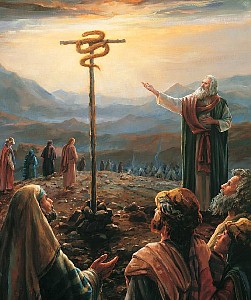
“So Moses made a bronze serpent, and put it on a pole; and so it was, if a serpent had bitten anyone, when he looked on the bronze serpent he lived.” Num 21:9

“And as Moses lifted up the serpent in the wilderness, even so must the Son of Man be lifted up, that we might become the righteousness of God in Him.” John 3: 14, 15

“For He made Him who knew no sin to be sin for us, that we might become the righteousness of God in Him.” 2 Cor. 5:21

“Look to Me, and be saved, All you ends of the earth! For I am God, and there is no other.” Isa.45:22

“He…broke in pieces the bronze serpent that Moses had made; for until those days the children of Israel burned incense to it; calling it Nehushtan.” 2 Kings 18:4

Don’t be too hard on those wandering Israelites. I’m sure we would have complained just as much, if not more. To know you’ll be wandering aimlessly for forty years, without ever laying eyes on your destination! Talk about discouraging! Even though they left a harsh life of slavery, now they were only remembering the good things they left behind. (Ex. 16:3) They remembered the food, water, permanent lodging, variety in their diet, and more than enough flavourful food. Instead they were compiling cookbooks; 101 Ways to Cook Manna.

They had forgotten that this was a miracle. God rained bread on them from Heaven, for forty years, six days a week. The manna did not run out. They always had enough. (Ex. 16:18). Yet at this point they had only begun the steady 40 year diet of manna. They would not eat other food again until they came to the border of Canaan. (Ex. 16:35) Already they were tired of it. They did not appreciate God’s provision. They grumbled to Moses, not realizing they were really complaining to God .

“And the people spoke against God and against Moses; ‘Why have you brought us up out of Egypt to die in the wilderness? For there is no food or water, and our soul loathes this worthless bread.’” Num. 21:5

Not for the first time, and not for the last time, God disciplined His people. In this case He sent fiery serpents among them and many died of snake bites. As is usually the case, punishment makes you see the error of your ways. They knew they had to approach God through a mediator. Moses intercedes for the people, confessing their sin against God, and imploring Him to stop the punishment. (Num. 21:7)

God could have removed the snakes as easily as He sent them. But instead, He has Moses make an image of a bronze serpent on a pole. He does this to further test His people. They are told that in order to be cured from snake bite, they must look at this serpent on a pole.

It was made of brass to represent judgement (see Ex. 27:2,Rev.1:15, 2:18).  It represents Christ because the judgment He endured was right and true, and came down from the God of heaven.

It required faith in what God said to do it His way. They had to have faith that God’s word was enough to save. It may have seemed ridiculous. Just look at a representative of the problem? No matter how desperate their case, one look in faith would be enough to cure them.

We know this is a beautiful picture of Christ and the simple offer of the Gospel because Jesus Himself makes the connection (John 3:1415) No matter how scarlet our sins, one look in faith will save us. He also signifies how He will die; by being “lifted up” on a cross.

How is Jesus like a serpent? Just as the image of the serpent was the cure for the problem of snake bite, so Jesus, on the cross took our sin on Himself. When Christ took the burden of our sin, He became the remedy for our sin. We can do nothing to save ourselves, just as the Israelites could do nothing to save themselves. We must look to Him by faith. God himself has provided the remedy. (2 Cor.5:21)

So is this too easy? Yes and No. Yes, because all we have to do is believe in the sufficiency of the finished work of Christ. We do not need to add any of our own works to it. Indeed, we dare not. (Isa. 45:22, Heb. 12:2). No, because a life of faith is never easy. Our tendency is always to want to add to it. We are proud of our accomplishments, our disciplined life, even our faith. Our minds are idol-factories. We must avoid that.

Look what happened as time went on. The children of Israel were so thankful for being healed in this miraculous way. So thankful in fact, they started to think the bronze serpent on the pole was the cause of their miraculous cure, rather than God. They created an idol of it, gave it a name, and began to worship it. King Hezekiah destroyed it so they could no longer worship it. (2 Kings 18:4) See what I mean? We’re idol makers.

We have to have Jesus only, not Jesus plus anything else. Only faith in Jesus is our remedy for sin.

Prayer-“Father, forgive me when I grumble against Your provision, as if it wasn’t good enough. Forgive me for trying to add to your finished work on the cross, as if my paltry deeds could improve on your sacrifice. Help me to have faith in Christ alone, and not make idols in my heart.”

Questions-There were three key areas wherein the Israelites failed. First, they complained against God’s provision. Then they didn’t believe the simplicity of the cure. Finally, they made an idol of the symbol. Do you see yourself in any of these scenarios, or even all of them? I think I would have been a grumbler, personally.

Response-Consider and list at least 50 things in your everyday life that are blessings from God that you take for granted. Thank Him in prayer, naming them.

Christ in the Book of Esther

23 Jul

Christ in the Book of Esther:  A Favoured Representative of the Chosen People

Read the whole book of Esther

Many of the Scarlet Threads we find in Scripture are represented by men; like Joseph, David, Jonah, and Melchizedek. We also see inanimate objects symbolizing our Redeemer; the rock smitten for us, the serpent on the pole, the scarlet thread, and manna. But here in the book of Esther, we see Queen Esther, herself, as a type of Christ.

Some criticize this book, since God is not explicitly mentioned. Yet He is everywhere present. He arranges to have Esther become Queen.  “Yet who knows whether you have come to the kingdom for such a time as this?” Est. 4:14b Mordecai believes even if Esther is disobedient, God will raise up deliverance from another quarter, because he had faith that God was not restricted in His plans, and would surely continue to preserve His people until the Messiah would come. Other events ‘just happen’, such as Mordecai’s discovery of a plot against the king; the king’s sleepless night where he happens to ask for some court documents to be read to him to bore him back to sleep, and they happen to read the part about Mordecai. There are no coincidences in the great plan of God.  He is in the book of Esther as the God of Providence and as a picture of Christ interceding for His chosen people.

Esther was a Jewess, although her husband, King Xerxes did not know this at first. “Esther had not revealed her people or family, for Mordecai had charged her not to reveal it.”  Est.2:10 When Haman encouraged the King to make an unchangeable law that would annihilate the Jewish people in one day, Mordecai appealed to Esther to use her favoured  position to appeal to the King.

Christ has two natures; human and divine. This makes Him the perfect Intercessor. As a man, He can sympathise with us. “For we do not have a High Priest who cannot sympathize with our weaknesses, but was in all points tempted as we are, yet without sin.” Heb. 4:15 Yet He has the favour of His heavenly Father, the King of Kings and Lord of Lords, because of the special relationship between Father and Son. “For the Father loves the Son, and shows Him all things that He Himself does…” John 5:20 Because of this relationship to His Father, He could approach Him with confidence, knowing he would receive favour from Him. “You are my Son, today I have begotten You. Ask of me, and I will give You the nations for your inheritance, and the ends of the earth for Your possession.” Psalm 2: 7, 8

To a lesser degree, Esther could sympathize with her people. “For how can I endure to see the evil that will come to my people? Or how can I endure to see the destruction of my countrymen?” Est. 8:6  Yet only she could have an audience with the King,  who loved her. “The King loved Esther more than all the other women, and she obtained grace and favour in his sight more than all the other virgins; so he set the royal crown upon her head and made her Queen instead of Vashti.” Est.2:17 “What do you wish, Queen Esther? What is your request? It shall be given to you—up to half the kingdom!” Est. 5:3

Esther is willing to be numbered with her people. Mordecai warned her not to assume that she would be safe from the decree because she was royalty. “And Mordecai told them to answer Esther: ‘Do not think in your heart that you will escape in the king’s palace any more than all the other Jews. For if you remain completely silent at this time, relief and deliverance will arise for the Jews from another place, but you and your fathers will perish. Yet who knows whether you have come to the kingdom for such a time as this?’” Est. 4:13,14

She shows courage, rather than resignation when she determines to go before the King, regardless of the consequences.  “…and so I will go to the King, which is against the law; and if I perish, I perish.” Est. 4:16b Christ went to Jerusalem, “his face set like a flint” even though He knew He would die there.

Esther was approaching a pagan king, not sure she would obtain favour, since she had not been summoned for a month.  Christ approaches the Father on our behalf, knowing He will be heard. “…Father I thank You that You have heard Me. And I know that You always hear Me…” John 11: 41b, 42a.

Secondarily, for us, because of Christ’s work, we can approach the very throne room of the King of Kings and ask Him anything. “Let us therefore come boldly before the throne of grace, that we may obtain mercy and find grace to help in time of need.” Heb. 4:16

Esther had to worry about the sentence of death hanging over her head; we can approach because of promises of grace and favour. Because of the King’s love for Esther, he found a way to spare her people, without compromising his law. Likewise God the Father ‘found’ a way to extend mercy to us, while still upholding the standard set by His law, and punishing sin. “Being justified freely by His grace through the redemption that is in Christ Jesus, whom God set forth as a propitiation by His blood, through faith, to demonstrate His righteousness, because in His forbearance God passed over the sins that were previously committed, to demonstrate at the present time His righteousness, that He might He might be just and the justifier of the one who has faith in Jesus.” Rom. 3:24-26

In the Cross we see the wisdom of God in that He does not compromise His own holiness nor the necessity of a remedy for our sin. Jesus, the God-man takes the punishment due to us on Himself, providing a propitiation, or an appeasement of the wrath of God, so that we may approach Him without fear.

Prayer– “Thank you, Lord for being my Intercessor. You understand my predicament, and You alone are qualified to appeal to God on my behalf, because of Your finished work. Thank you that because of what you’ve done, I can now approach the throne of grace to obtain mercy, and find grace to help in time of need.”

Questions– Have you seen the Providence of God at work in your life? Does the knowledge of the sovereignty of God in the affairs of life cause you to feel peace or distress? When my husband was diagnosed with cancer when he was thirty-five, it was such a comfort to me to know that our situation did not take God by surprise, and that because He planned for it to come into our lives, He would also be with us. And He was.

Response– Pray for those in authority, “that we may lead a quiet and peaceable life in all godliness and reverence.”  1 Tim. 2:2 Pray for those in leadership in your life; in your home, at your work, in your church, your neighbourhood, your city, your province, your country. Send them an encouraging message and tell them you are praying for them.

Christ as the Sacrificed Son in the Book of Genesis

14 Jun

Read Genesis 22

“Then He said,’Take now your son, your only son, Isaac, whom you love, and go to the land of Moriah, and offer him there as a burnt offering on one of the mountains of which I shall tell you.’” Gen. 22:2

One of the most beautiful ways Jesus is portrayed in the book of Genesis is as the sacrificed son of promise, presented to us in the narrative of Genesis chapter 22.

Abraham and Sarah had waited a long time for God to fulfill His promise to them. Deciding maybe He meant for them to figure it out, they took matters into their own hands. Sarah gave her servant, Hagar to Abraham; Ishmael was the result.

But the son of the bondwoman was not the child of promise, Isaac was. Because of Isaac, Sarah and Abraham experienced joy in their old age. God had not forgotten His promise. He never does. It may just seem that way from our perspective.

Fast forward. Isaac is a young man. He doesn’t know that God has spoken to his father in the night, and he’s about to have a day he’ll never forget. Notice though, how God shows He understands the magnitude of the sacrifice He is asking Abraham to make. He knows, because one day, He’ll do it, too, but no one will stay His hand.

He says, “Take now your son, your only son, Isaac, whom you love, and offer him …” Gen. 22:2   Wait. What? “Your only son”? What about Ishmael, the firstborn? Doesn’t he count? Not in terms of Redemption. It’s the son of Abraham and Sarah who is the son of promise. Ishmael represents the rejected bondwoman’s son, those who believe they can be saved by works. God’s plan is much better. Gal. 4:21-31

Read verse three. Notice that? “So Abraham rose early in the morning…” I know it’s stating the obvious, but in order to wake up you have to have gone to sleep. How could he have slept? More than that, he woke up early, eager to obey. I would’ve pressed the snooze button a few times at least. Notice also, that there’s no record of his telling Sarah what God had told him. With good reason. That would not end well. This is her baby, regardless of his age.

I find Isaac’s question to his father so heart rending. He understands what is needed for a sacrifice, and sees there’s something missing. “Look, the fire and the wood, but where is the lamb for a burnt offering?” Gen. 22:7 This shows us the concept of a lambs and burnt offerings was not foreign even before the Law was given. I’m sure Abraham swallowed the lump in his throat and could not look at Isaac as he answered, “My son, God will provide for Himself the lamb for a burnt offering.” Gen. 22:8

And hasn’t He done that in history? All the repeated sacrifices of animals throughout the centuries only pointed forward to the perfect Sacrifice, which would put an end to all other sacrifices; the One provided by God, Himself. “The Lamb of God, who takes away the sin of the world!” John 1:29 God took His Son, His Only Son Whom He loved, and sacrificed Him.

Did Isaac protest or struggle as Abraham bound him on the altar? There’s no record of it in Scripture so I’d conclude no. There was no, “Father, what are you doing?” or “How could you do this?” or “Please, Father, no.” Just submission to his father’s will, even though he knows it means an excruciating death at the will of his own Father.

Christ was the son of promise. All of history is His Story. All the types and shadows pointed to Him, the promised One, beloved of the Father. He was God’s “Son, His only Son, whom (He) loved.” “This is my beloved son”. Matt. 3:17 He also gladly submitted to His Father’s will, even knowing what it would cost Him. “What shall I say? Save Me from this hour? It was for this hour that I came forth. Father, glorify Your name.” John 12:27,28 and “In the volume of the book it is written of Me. I delight to do Your will.” Heb.10:7

Seemingly out of nowhere, after God/the Angel of the LORD tells him not to lay a hand on the boy, a ram appears. It’s significant that Scripture records the detail that it was caught in a thicket by its horns. This would mean its body would be unblemished, and so would be a suitable sacrifice.

In this narrative we see Christ as the sacrificed son, but we also see him as the substitute for the one under sentence of death. A thicket is a mass of thorns, and represents sin, and horns are a symbol of strength. So we see Christ pictured as held fast by sin, for us. Then the ram is offered up, “instead of his son.” Gen. 22:13 Here we see a beautiful picture of substitutionary atonement.

JD Greear  says, “Jesus did not merely die ‘for’ you, he died ‘instead’ of (2 Cor 5:21)

Abraham’s hand was held back by God. He was really going to do what God commanded. God knew his heart and his motives. He also saw his faith that in spite of this, God would keep his promise. As they were approaching the mountain, Abraham left the servants to wait, promising that, “the lad and I will go yonder and worship, and we will come back to you.” Gen. 22:5 Notice he saw what he was about to do as an act of worship. He didn’t say they would both return because he was lying to his servants or because he didn’t intend on following through on God’s command. In the book of Hebrews we’re told that Abraham believed God was able to raise him from the dead.

“By faith Abraham, when he was tested, offered up Isaac, and he who had received the promises offered up his only begotten son, of whom it was said, ‘In Isaac your seed shall be called,’ concluding that God was able to raise him up, even from the dead, from which he also received him in a figurative sense.”                     Heb. 11:17-19   It was impossible for God to lie. Abraham was so sure of God’s character and God’s word. After all, He had already given Isaac to him, as He’d promised. “And Abraham believed God, and it was counted to him as righteousness.” Gen. 15:6 Abraham would do as God commanded, even though it seemed to go contrary to His promise that through Isaac the world would be blessed.

After the Angel of the LORD stayed his hand, He again reiterated the promise to multiply his descendants as the stars of the heaven and as the sand of the seashore.” He also tied the blessing into Abraham’s obedience. “In your seed all the nations of the earth shall be blessed because you have obeyed My voice.”   Gen. 22:18   But many years later, God the Father didn’t hold back His hand. He slew His own Son. Jesus felt the rejection of His Father as the worst part of the crucifixion.

“My GOD, my GOD, why have You forsaken Me?” Matt. 27:45 The answer: “For You are Holy.” Psalm 22:5   It was His Plan A. Jesus was “the Lamb slain before the foundation of the world.” Rev. 13:8 That’s why all these narratives were given to us. Not just to entertain us or teach us a lesson in themselves. They were all glimpses of the future, and the great mystery hidden from the ages, but now revealed to us. Col. 1:26 It was the Master Plan. God meant to do this.   “He who did not withhold His own Son…” Rom. 8:32

“Jesus is the true and better Isaac who was not just offered up by his father on the mount but was truly sacrificed for us. And when God said to Abraham, ‘Now I know you love me because you did not withhold your son, your only son whom you love from me,” now we can look at God taking His Son up the mountain and sacrificing him and say, ‘Now we know that you love us because you did not withhold Your Son, Your Only Son, whom You love from us.’” Timothy Keller

“Neither Abraham, Isaac, nor any Israelites at that time could have ever fully grasped that God would one day not only demand sacrifice, dictate the sacrifice, substitute the sacrifice, and be satisfied with sacrifice, but would also actually become the sacrifice.” Dr. David P. Murray

Prayer– “There are times when what we read in Scripture is so overpowering to our souls. This account is one of them for me. I can’t imagine Abraham’s thoughts. I cannot fathom the kind of faith it takes to rise up early to obey. I don’t know if I would have that kind of faith to trust that if I killed my son, You would raise him up again. At the same time, I see beyond this narrative to the greater story behind it. The story of what my salvation cost You. It cost You Your Son. You did not hold back your knife of judgment, but buried it in the body of Your Son on the Cross. I stand amazed at Your willingness to part with Him when He came to earth, I stand even more amazed at Your willingness to allow Him to be killed by His creatures, and His willingness to be sacrificed for our sin. Thank You for so great a salvation.” Amen.

Questions– Are you holding anything or anyone more dear than God? Do you need to lay your “Isaac” whatever it may be, down on the altar and let God demand what He may? A scary thought, to be sure. But consider what God has done for you in giving His own Son. Now reconsider if you need to cling to it.

Response-Spend time alone with God and consider all the things you were sure were God’s plan for your life. Perhaps they are, but ask yourself if you’d be willing to let them go if God were to simply ask you.